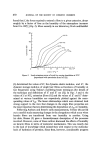
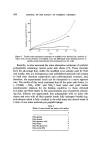
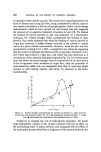
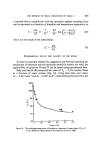
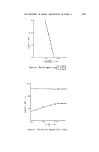
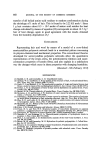
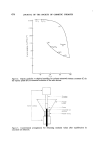
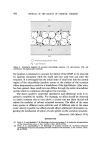
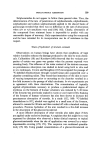
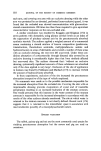
454 JOURNAL OF THE SOCIETY OF COSMETIC CHEMISTS õ •o .-- -- ! 0 20 40 60 80 I00 %rh Figure 6. Typical water adsorption isotherms of modified wool. Broken line, isotherm of virgin wool (a) the isotherm of modified wool (b) differential water binding isotherm of specific groups [reproduced with permission from ref. (14)]. Recently, we also measured the water adsorption isotherms of synthetic polypeptides containing various polar side chains (15). These materials have the advantage that, unlike the modified wool samples used by Watt and Leeder, they are homogeneous and well-defined materials with respect to both their chemical composition and conformational structure, and, therefore, the experimental result can be interpreted in a more rigorous way. The results of this work confirmed that all the polar side chains, i.e. (--COOH, --NH•, COO- and NHa +) bind water and yield similar stoichiometric relations for the binding equilibria to those obtained by Leeder and Watt (Table I). The measurements also revealed the interest- ing fact, hitherto not appreciated, that polypeptides with no polar side chains and even with all their peptide bonds fully hydrogen bonded (e.g. poly-alanine which is fully e-helical in the solid state) also absorb water in a ratio of one water molecule per peptide linkage. Table I Moles of water bound per amino acid residue Poly-glycine 1 Poly-alanine 1 Poly-glutamic acid 2 Poly-lysine 4 Poly-Na glutamate 3 Poly-lysine HBr 4

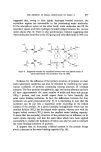
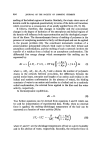
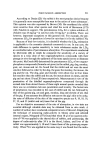
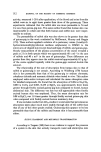
THE BINDING OF SMALL MOLECULES TO HAIR--I 455 The water adsorption isotherms obtained were interpreted on the basis of a co-operative binding model derived by Schwarz (16). This model postulates the existence of two types of chemical equilibria between binding sites attached to the polymer and the small molecule: firstly, an equilibrium with sites flanked by two other unoccupied sites K* W + uuu • uwu and secondly, an uptake equilibrium with a site where at least one of the neighbouring sites is already occupied K W + uwu • uww (The symbols W, u, w, K* and K denote a water molecule, an unoccupied site, a site occupied by a water molecule, and the appropriate binding constants, respectively.) The values of K and K* were evaluated from the experimental data and showed that practically all the water binding sites of polar groups in synthetic polypepfides have binding constants and free energies of binding of similar magnitudes (Table II). An important result which also emerged both from our work on polypeptides and from that of Leeder and Watt on wool, is that the free energies of binding seem to be about four to five times larger than the thermal energy, suggesting that, at ambient temperatures, the water is fairly firmly bound to the polar sites of the protein. This argument is also Table II Binding constants and free energies of binding of water K AGo AG½o-op (1 mole -x) (kJ mole -z) (k.l mole -z) PGly I 6.8 x 10 • - 14.4 - 2.2 PGly II +1.5 x 10" +3.5 4-0.4 --COOH • 8.5 x 10 •' -13.1 -4.1 --NH•. 4-1.5 x 10 •' 4-3.5 4-1.0 --COO- Na + • 1.75 X 10 •' - 16.1 - 2.9 --NHa + Br- 4-0.15 X 10 •' 4- 3.5 4-0.5 A G o, Free energy of binding of water A Geo-op, free energy the co-operative interactions between bound water mole- cules.
Purchased for the exclusive use of nofirst nolast (unknown)
From: SCC Media Library & Resource Center (library.scconline.org)