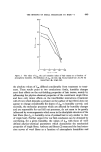
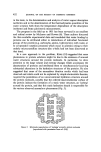
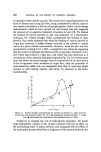
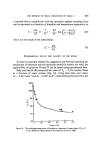
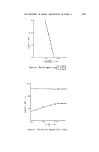
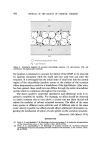
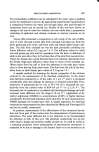
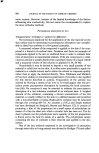
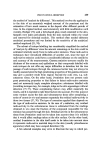
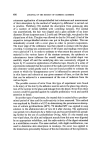
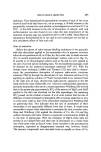
460 JOURNAL OF THE SOCIETY OF COSMETIC CHEMISTS co-operative water sheath can exist. His results were in good agreement with those of Strauss and Leung (23) who, using a dilatemetric method, came to very similar conclusions in the case of polyphosphates. Some volume change measurements which we have carried out with human hair also suggested the presence of co-operative hydration structures in hair (24). We studied the binding of various phenols to hair and measured, by a dilatemetric technique, the volume changes which accompanied the binding of these phenols. Our results indicated that when the binding of various phenols to virgin hair occurred, a sudden change occurred in the volume vs uptake curves at a given critical concentration. However, when the hair was first penetrated by soaking in 0.1 N HC1, a straight line was obtained, suggesting that the acid pre-treatment had destroyed the co-operative hydration struc- ture which had existed in virgin hair, and which was also destroyed as a consequence of the relatively high phenol uptake (Fig. 11). It is interesting to note that minor structural changes must be responsible for the destruction of the co-operative water structures in virgin hair, since the properties of acid-treated hair differ only very marginally from that of virgin hair (slight increase in acid binding capacity and about 2•o decrease in the elastic modulus) (24). • 4- o• x '•'" 2 I o I 2 3 4 r x I0 • mole g-I Figure 11. Volume changes accompanying the sorption of phenols on virgin and acid- treated hair (hair exposed to pH 1 for 12 h and subsequently washed acid free). O, Virgin hair ß acid-treated hair [reproduced with permission from ref. (24)]. Finally let us consider the role of hydrophobic hydration. No doubt large hydrophobic regions of the protein molecule will have an effect on the surrounding water. It seems, however, that compared with the effects of the many polar groups which form a large part of the protein molecule, the

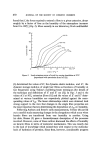
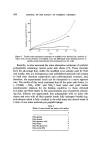
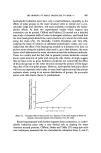
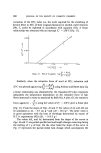
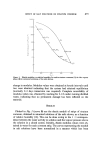
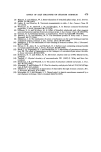
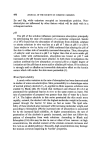
THE BINDING OF SMALL MOLECULES TO HAIR--I 461 hydrophobic hydration must have only a small influence, especially as the effects of polar groups on the water structure seem to extend over a con- siderable range and, therefore, will most probably overshadow the hydro- phobic effects. At least two experimental results which support this contention can be quoted. Clifford and Pethica (25) carried out a detailed mr study of chemical shifts of water in detergent solutions, and found that the ionic head groups disturb the water structure up to about the sixth atom along the chain (Fig. 12). Secondly, Corkill, Goodman and Tate (26), studying the heats of solution of alkylated polyethylene oxides, also con- cluded that the effect of the head group extends to a distance of at least six carbon atoms along the aliphafic chain and is, up to that distance, the main factor which determines the water structure around the surfactant molecule. These two results, and the fact that in general, protein molecules contain about equal amounts of polar and non-polar side chains, strongly suggest that (at least as far as gross hydration properties are concerned) the effect of the polar groups on the water structure around the protein will be larger than that of the non-polar groups. However, hydrophobic hydrafion effects will have an important role to play in some local regions around the protein molecule where, owing to an uneven distribution of groups, the non-polar amino acid side chains chance to predominate. -o oc 0,3 •.._• 0,2 • o 2 4 G 8 IO 12 Chain length of alkyl sulphate Figure 12. Chemical shift of water proton as a function of the chain length of dissolved aliphatic anion [reproduced with permission from ref. (25)]. Recent experimental work further supports these contentions, i.e. hydro- phobic hydration plays only a very limited role in shaping the water structure around proteins. Clifford, Oakes and Tiddy (27) using spin echo nmr techniques, measured the two characteristic relaxation times T• and T•
Purchased for the exclusive use of nofirst nolast (unknown)
From: SCC Media Library & Resource Center (library.scconline.org)