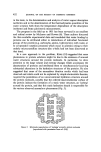
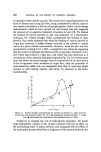
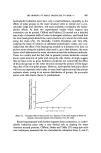
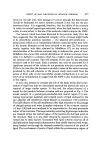
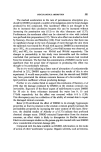
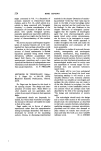
462 JOURNAL OF THE SOCIETY OF COSMETIC CHEMISTS of water molecules in the neighbourhood of polystyrene latex particles and in the lamellar D phase of the sodium caprylate-decanol-water system. They reached the conclusion that for systems containing layers of water more than 2 nm thick, all the effects observed can be explained in terms of the binding of a few water molecules to --COO- groups. Where the water thickness layer is 2 nm there is a marked reduction in water molecular mobility as the normal water structure ceases to exist and is replaced by a more rigid structure determined by the interaction of water with charged surface groups, counter ions, and hydrogen bonding surface groups. Thus, it appears that special water structure effects must be allowed for only for such relatively narrow water layers. This view has gained further confirmation by some recent light scattering studies on protein solvation (28). In conclusion, therefore, it can be stated that the hydration structure of keratin, and probably of other proteins, consists almost entirely of water molecules bound to discrete hydrophilic sites. THE MOLECULAR MODEL FOR KERATIN A number of molecular models have been suggested for keratin by various authors (29-34). These differ in many of the assumptions and abstractions they make nevertheless, for practical purposes they account equally well for the measured physical and chemical properties of keratin. The various models are in effect indistinguishable as far as their validity is concerned, owing to the limits in the accuracy of the experimental data which can be obtained for checking these models. For the purpose of the present discussion the 'polyelectrolyte gel' model seems the most convenient (Fig. 13). Its use for fibrous proteins was first suggested by Flory (31) and since then it has been successfully applied for explaining the acid uptake (35), the strain stress properties [both qualitatively (31) and quantitatively (36, 37)], the supercontraction (38) and the thermoelastic (5) properties of keratin fibres. Essentially this model regards hair as a polymeric network in which the chains are either in an e-helical crystalline or in an amorphous conforma- tion. The polymeric chains carry acidic, basic and neutral sites capable of binding cations, anions and neutral molecules respectively (carboxylic, amino, peptide groups). Application of an axial stress, provided the exten- sion does not exceed 15•, causes the disorganization of the crystalline regions, which become transformed to random conformations. After

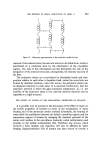
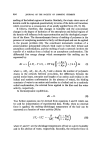
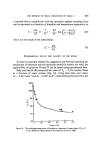
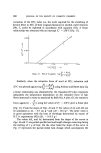
THE BINDING OF SMALL MOLECULES TO HAIR--I 463 S-S S-S ,• S-S S-S ' Figure 13. Schematic representation of the molecular model for hair. removal of the external stress, the network returns to its stable form, which is manifested on a molecular level by the reformation of the crystalline regions. The rate of this reformation process determines the rate of the dissipation of the internal stress and, consequently, the internal viscosity of the fibre. The polymeric chains are cross-linked by disulphide bonds and their position relative to each other is therefore fixed, unless the cross-links are broken by chemical reactions when this occurs, the polymeric chains can be displaced relatively to each other. It is assumed, furthermore, that the polymeric network is below the glass transition temperature, Tg, i.e. the mobility of the polymeric chain is low, and the network therefore can be regarded as a rigid structure. THE EFFECT OF WATER ON THE MECHANICAL PROPERTIES OF KERATIN It is possible now to proceed to the discussion of the effect of water on the tensile properties of keratins in terms of the mechanisms of water binding and of the molecular model outlined. Essentially, the binding of water shifts the equilibrium between the helical, crystalline regions and the amorphous regions of keratin by changing the chemical potential of the amino acid residues in the amorphous randomly coiled conformation and possibly in the helical conformation (34). Therefore, any process which involves a helix random coil transition will also be affected by water binding. Supercontraction (33) of keratin has been shown to involve a
Purchased for the exclusive use of nofirst nolast (unknown)
From: SCC Media Library & Resource Center (library.scconline.org)