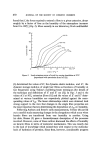
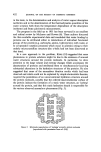
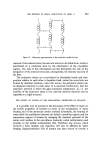
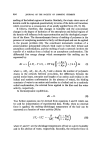
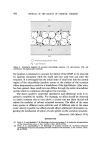
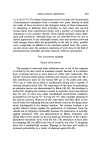
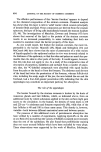
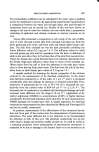
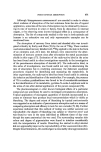
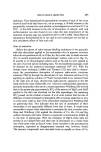
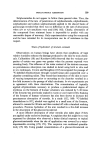
464 JOURNAL OF THE SOCIETY OF COSMETIC CHEMISTS melting of the helical regions of keratin. Similarly, the strain-stress curve of keratin could be explained quantitatively in terms of the helix coil transition which occurred as a consequence of an axially applied force (32, 35, 36). It follows, therefore, that changes in humidity and the concomitant changes in the degree of hydration of the amorphous and helical regions of the keratin will influence both supercontraction and the theological proper- ties of the fibres. The thermodynamic theory of melting of polymers in the presence of complexing materials is fairly well developed and can be applied to the present problem (34). The constituent monomeric residues of a semicrystalline polypeptide network bind water in both their helical and amorphous conformations, and the melting of such a network involves the transfer of n residues from a helical to an amorphous conformation. The differential free energy change which accompanies this melting can be expressed by: ( ) dG=u AHo-TAS o +RTlog +K•a +fAL dn (I) where u, AHo, ASo, AL, K, K•. f and a denote the number of polymeric chains in the network between cross-links, the differences between the partial molar heats, entropies and lengths of an amino acid residue in the helical and random conformation (in the absence of water), the binding constants of water to an amino acid residue in a helical and to a randomly coiled conformation, the external force applied to the fibre and the water activity, respectively. In thermodynamic equilibrium, dG = 0. (II) Two further equations can be derived from equations I and II which can be used for interpretation of experimental data. Firstly, when no external force is applied, the melting (shrinkage) temperature of the hair can be expressed as a function of water activity (39) by 1/T•_i/T•O_ R (1 +Kxa) AH-•- log 1 + K•.a' (III) where T s and Ts ø are the shrinkage temperatures of hair at a given humidity and in the absence of water, respectively. Secondly, the retractive force in

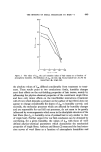
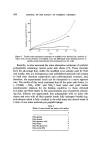
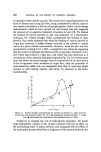
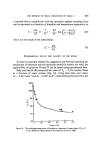
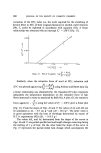
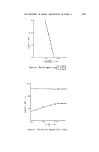
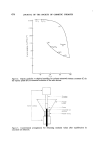
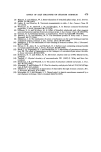
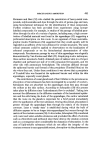
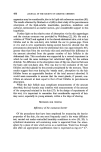
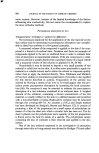
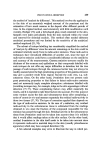
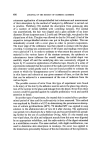
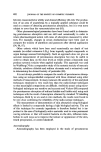
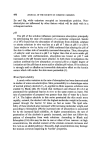
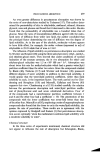
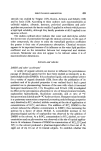
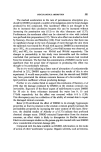
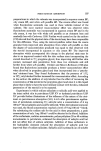
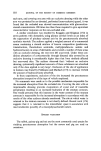
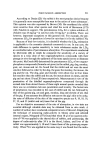
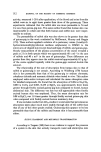
THE BINDING OF SMALL MOLECULES TO HAIR--I 465 a strained fibre in equilibrium with the externally applied extending force can be expressed as a function of humidity and temperature respectively by AHo (1-•? RT log (.1 +K•a) f- •'• q- A-•- 1 + K•a (IV) where use was made of the relationship: EXPERIMENTAL TEST OF THE VALIDITY OF THE MODEL In order to ascertain whether the suggestions put forward regarding the mechanism of hydration and the molecular model for keratin are valid, the applicability of equations III and IV can be tested using experimental data. Haly and Snaith (40) measured the value of Tm -- Ts for keratin fibres as a function of water content (Fig. 14). Using their data and values K• = 0.34 1 mole -• and Ks = 0.29 1 mole 4, determined previously from the 220 - 180 ,4ø I 120' I o 20 I I I I, 40 60 80 100 'Regoin'(%) Figure 14. The shrinkage temperature of keratin as a function of water regain (Tin= T s in our definition). [Reproduced with permission from ref. (40).]
Purchased for the exclusive use of nofirst nolast (unknown)
From: SCC Media Library & Resource Center (library.scconline.org)