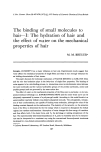
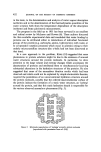
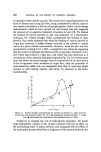
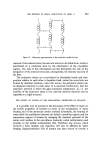
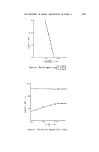
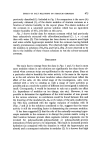
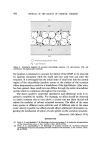
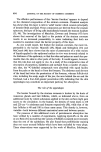
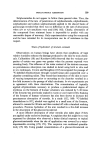
452 JOURNAL OF THE SOCIETY OF COSMETIC CHEMISTS in the main, to the determination and analysis of water vapour absorption isotherms and to the determination of the thermodynamic quantities of the water sorption both from the temperature dependence of the absorption isotherms and from calorimetric measurements. The progress in the field up to 1951 has been surveyed in an excellent and critical review by McLaren and Rowen (6). These authors discussed the then available experimental data and concluded that water binding by proteins can be attributed either to interactions of individual functional groups of the protein (e.g. carboxylic, amino, hydroxyl etc.) with water, or to co-operative sorption processes which occur in proteins owing to their orderly microcrystalline structure (the e-helix had not been discovered at that time). In a new approach to the problem, Klotz (10)suggested that some phenomena in protein solutions might be due to the existence of unusual water structures around the protein molecule. In particular, he drew attention to the large volume and entropy changes which accompany the denaturation of proteins and attributed them to simultaneously-occurring substantial alterations in the hydration structures of the proteins. He also suggested that some of the anomalous titration results which had been observed and which could not be explained by simple electrostatic theories, required the postulation of an unconventional hydration structure around the protein molecule, notably that the ordered macromolecular surface of the protein induces the formation of a static water structure, an 'iceberg' around the protein, and that this static hydration sheath is responsible for the various observed anomalous phenomena (Fig. 5). Figure 5. Schematic reproduction of 'icebergs' around a protein molecule [reproduced with permission from ref. (10)].

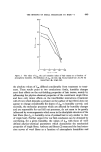
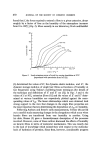
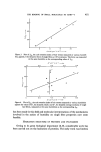
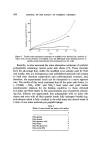
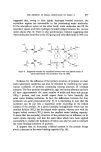
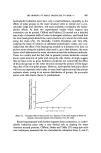
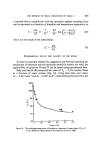
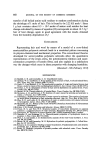
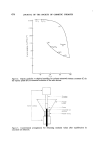
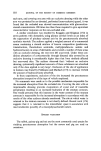
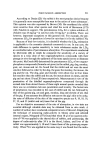
THE BINDING OF SMALL MOLECULES TO HAIRmI 453 On the basis of Frank and Wen's (11) work, Kauzmann (12) assumed, on the other hand, that water is a mixture of flickering clusters (hydrogen bonded aggregates of water molecules) and monomeric water molecules and that a protein molecule, with its many hydrophobic side chains, induces a higher probability of cluster formation in its immediate neigh- bourhood (i.e. it shifts the equilibrium between aggregates and monomeric water towards the direction of clusters). These basic ideas led then to Nemethy and Scheraga's (13) work who put the flickering cluster model of water on a quantitative footing. Nemethy and Scheraga's work opened up a great deal of new interest in water-solute interactions and a tremendous amount of work has been carried out during the last decade both on the structure of liquid water and on the structure of aqueous solutions. The expression 'hydrophobic interactions' became a household word of the biochemical and biophysical literature, so much so that it is difficult to find a paper in the protein literature today which does not refer in some part of its discussion to hydrophobic bonding or hydrophobic hydration as an interpretation of any unexplained phenomenon. Binding of water to sites During recent years new experimental results have become available which suggest that the interactions of the polar groups of proteins with water play a much more important part in determining the hydration structure than'was thought previously. In recent years Watt and Leeder in a series of papers [for summary see (14)] reported the measurement of adsorption isotherms of water on wool samples in which the various functional groups of the protein were systematically blocked by means of specific chemical reagents. Comparing the isotherms of modified samples with those of virgin wool samples from the same batch, differential water adsorption isotherms could be constructed which represented interactions of water molecules with particular functional groups (Fig. 6). In this way the adsorption isotherms of carboxylic groups, amino groups, hydroxyls (both aromatic and aliphatic) and of the backbone peptide groups were determined. The results of these measurements showed that charged carboxylic groups (COO-) complex with two water molecules, the charged amino groups with three, aliphatic hydroxyl (serine) with one and aromatic hydroxyl groups (tyrosine) with two water molecules. The adsorption isotherm of the peptide group, obtained by difference, extrapolated to a 1: 1 molar ratio of water to peptide group.
Purchased for the exclusive use of nofirst nolast (unknown)
From: SCC Media Library & Resource Center (library.scconline.org)