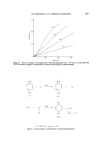
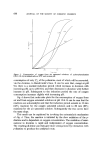
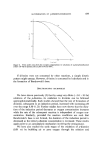
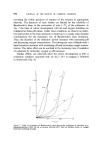
J. Soc. Cosmet. Chem. 23 683-693 (1972) ¸ 1972 Society of Cosmetic Chemists of Great Britain The autoxidation mine of ?-phenylenedia- J. F. CORBETT* Synopsis--The AUTOX1DATION of P-PHENYLENEDIAMINE is discussed in terms of data obtained from manometric, polarographic, and spectroscopic measurements, bearing in mind the effect of the subsequent fate of the initially formed dMmine on the EXPERIMENTAL observations. It is considered that the initial oxidation is autocatalytic and that the extent of CATALYSIS is dependent on factors which affect the rate of consumption of the dMmine to give p-benzoquinone monoimine and Bandrowski's base. Under non-enzymatic conditions the oxygen consumed is reduced only as far as hydrogen peroxide. INTRODUCTION It is well established (1-3) that the oxidation of p-phenylenediamine (I), by a variety of oxidants, results in the formation of Bandrowski's base, which has the structure (II) (4). It has also been shown (5) that oxidation by molecular oxygen results in the initial formation of p-benzoquinone di-imine (III). The mechanism of the conversion of the di-imine to Bandrow- ski's base has also been elucidated (6). This paper reports a study of the effect of reaction conditions on the rate of oxidation ofp-phenylenediamine. Lu Valle, Glass and Weissberger (7) used a manometric method to follow the rate of oxygen consumption by solutions ofoe-phenylenediamine. They found that the consumption showed autocatalysis and that the rate increased with increasing pH above pH 8.5. Between pH 6.5 and 8.5 the rate was minimal at pH 8.0 but was not markedly affected by pH. Cilento and Zinner (8) used spectroscopic techniques and reported that, in the pH range 6-8.5, the rate of reaction is maximal at pH 7.1. They were * Gillette Research and Development Laboratory, Reading, Berks., RG2 0QE. Now with Clairol Research Laboratories, 1 Blachley Road, Stamtbrd, Conn. 06902, U.S.A. 683

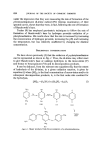
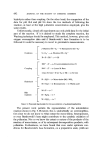
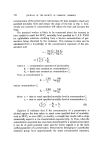
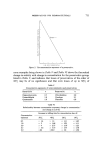
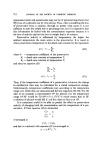
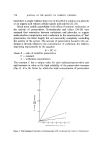
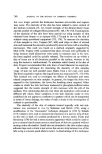
684 JOURNAL OF THE SOCIETY OF COSMETIC CHEMISTS under the impression that they were measuring the rate of formation of the p-benzosemiquinone di-imine radical (IV) whereas examination of their spectral curves, shows that they were, in fact, following the rate of formation of Bandrowski's base. Tucker (9) has employed gravimetric techniques to follow the rate of formation of Bandrowski's base by hydrogen peroxide oxidation of p- phenylenediamine. His results show that the rate is increased by increasing the concentration of hydrogen peroxide, increasing the pH, and increasing the temperature, but was relatively unaffected by changing the diamine concentration. PRELIMINARY CONSIDERATIONS We have shown previously (5) that the oxidation ofp-phenylenediamine can be represented as shown in Fig. 1. Thus, the di-imine may either react to give Bandrowski's base or undergo hydrolysis to the mono-imine (V) and thence to benzoquinone (VI) and its decomposition products. It can be deduced, from the relevant rate equations (6), that the extent of hydrolysis of the di-imine, in a given oxidation reaction, is given by equation (i) where [M] oo is the final concentration of mono-imine and/or its subsequent decomposition products, kh is the first order rate constant for the hydrolysis, [1141oo =(kh/3kc) In (3kc[P]o +kh)/kh (i) NH2 NH NH 0 0 ox. 0 0 0 NH• NH 0 0 (I) H 2 N (II1) (v) NH• N • N •NH2 NH2 (II) (vI) 'Humlc acid' Figure 1. Major products from the autoxidation ofp-phenylenediamine.
Purchased for the exclusive use of nofirst nolast (unknown)
From: SCC Media Library & Resource Center (library.scconline.org)