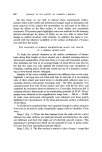
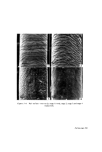
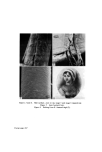
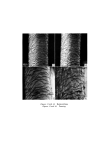
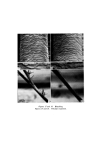
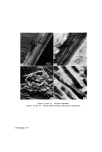
702 JOURNAL OF THE SOCIETY OF COSMETIC CHEMISTS For combing alone the rate of loss of cuticle was about 0.5 •tm after 2 000 comb strokes. Since the average length of each cuticle scale along the fibre axis is 40 •tm, some 160 000 comb strokes would be required to remove all the cuticle. The average rate of growth of human hair is 0.35 mm day -•, therefore the removal of all the cuticle at a distance of 40 cm from the scalp would require the subject to comb her hair at the rate of 150 comb strokes day 4. Clearly this is unlikely to happen, therefore the total lack of cuticle we have observed 40 cm from the scalp cannot have been due solely to combing, and other factors such as handling, exposure to sunlight, washing etc. must also contribute. That only small fragments chip from the edges of the scales occurs with such treatments as combing rather than the gross stripping away of the cells perhaps indicates that the cuticle is inherently brittle. This is not surprising in view of the fact that one of the major lamina of which each scale is composed (the exocuticle) is very highly cross-linked (containing some 30-40• cystinc w/w) (4). Since we have shown that cleavage occurs mainly along the cuticle cell membranes, and to a lesser extent in the sulphur-poor endocuticular lamina, it would appear that these components are mechanically the weakest in the cuticle. Indeed this confirms earlier observations (5) in which we have shown that bleaching and perming tend to extract small amounts of the cuticle cell membrane. ACKNOWLEDGMENTS We are indebted to Mr T. C. Hughes and Miss S. J. Williams and Miss P. McCarthy who have contributed to some of the work recorded here. Grateful thanks are also due to the trustees of the Jane Austen Society and particularly to Sir Hugh Smiley, Bt. and Miss E. Jenkins for permitting us to examine the lock of Jane Austen's hair and to reproduce Fig. 8. (Received: 13th April 1972) REFERENCES (1) Swift, J.A. New developments in electron microscopy. J. $oc. Cosmet. Chem. 22 477 (1971). (2) Austen, C. 'My Aunt Jane Austen'. 1867 manuscript republished by The Jane Austen Society, Chawton, Hants (1952). (3) Austen-Leigh, J. E. 'A Memoir of Jane Austen'. 1871, Richard Bentley & Sons, London. (4) Swift, J. A. The electron histochemistry of cystinc-containing protein in thin transverse sections of human hair. J. Roy. Microsc. Soc. 88 449 (1967). (5) Swift, J.A. Electron microscope studies of diffusion in human hair. Proc. 3rd Int. Cong. Wool Text. Res. Paris I 265 (1965).

J. Soc. Cosmet. Chem. 23 703-720 (1972) ¸ 1972 Society of Cosmetic Chemists of Great Britain Preservatives for pharmaceuticals H. S. BEAN* Presented on 29th September 1971 in London, at the Symposium on 'Microbial control', organized by the Pharmaceutical Society of Great Britain and the Society of Cosmetic Chemists of Great Britain. Synopsis--Examination of the literature strongly indicates that PRESERVATIVE activity should be biocidal rather than biostatic and underlines the necessity of establishing STAN- DARDS for preservative activity, such standards to include requirements for the rate of kill or time to sterilize specified standard infections in a product and a specification for the capacity of the preservative to deal with successive infections of the product. The chemical availability of a preservative in a product may alter during STORAGE as a result of absorption by the package, in-use infection, or change in storage temperature and the microbiological significance of the loss may be estimated from a knowledge of the concen- tration exponent and/or temperature coefficient of the preservative. The preservative activity of a substance may be markedly influenced by product environ- ment, the more complex the product the greater the number of factors influencing the activity with the result that the preservative activity of a simple AQUEOUS SOLUTION can usually be stated with greater confidence than that of an EMULSION. Nevertheless, with the aid of mathematical models and a knowledge of the appropriate parameters it is often possible to predict the activity of a fluid containing SURFACE ACTIVE AGENTS or an emulsified preparation with acceptable accuracy. For several decades pharmacists have been aware of the need to protect their products against microbial contamination but it is only during the last one or perhaps two decades that serious thought has been applied to the science of preservation. A search through pharmaceutical compendia and texts reveals very few 'traditional' preservatives including ethyl alcohol at a concentration of not less than 20•o, chloroform at 0.25•o, sucrose at 67•o and benzoic acid at 0.1 •o. That they are still used is testimony to their effectiveness but *Department of Pharmacy, Chelsea College of Science and Technology, London, S.W.3. 703
Purchased for the exclusive use of nofirst nolast (unknown)
From: SCC Media Library & Resource Center (library.scconline.org)