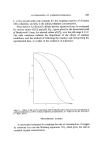
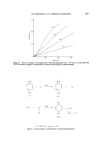
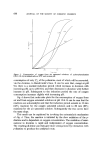
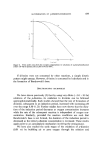
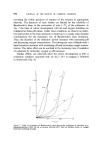
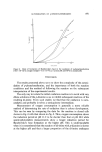
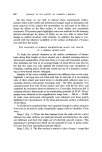
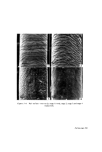
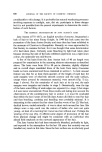
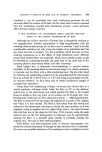
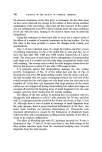
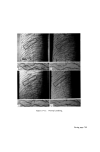
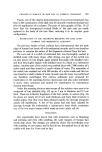
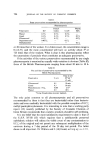
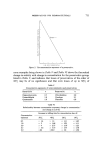
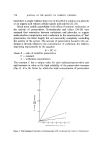
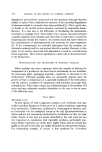
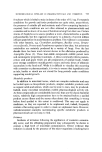
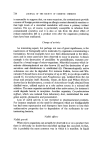
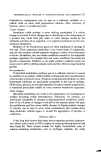
AUTOXIDATION OF tO-PHENYLENEDIAMINE 691 75- 25 25 50 75 l•me (m•n) Figure $. Rate of formation of Bandrowski's base in the oxidation of p-phcnylcncdiamin½ (10.0x 10-a•) by oxygen (oxygen= 0.2x 10•a•) at various pH and 30øC in closed •lls. DISCUSSION The results presented above serve to show the complexity of the autoxi- dation of p-phenylenediamine, and the importance of both the reaction conditions and the method of following the reaction on the subsequent interpretation of the experimental results. The only way to isolate the initial oxidation reaction is to work with very dilute solutions of the p-diamine so as to inhibit subsequent reactions of the resulting di-imine. From such studies we find that the oxidation is auto- catalytic and probably involves a semiquinone intermediate. Measurement of oxygen consumption is generally a more reliable method of determining the rate of oxidation than is colour development. This can be seen by comparing the data for the reaction in closed cells shown in Fig. 6 with that shown in Fig. 8. Thus, oxygen consumption shows the induction period at pH 11.2 to be shorter than that at pH 10.8 while spectrophotometric measurements show a longer induction period for Bandrowski's base formation at the higher pH. This is understandable when it is remembered that the reaction of di-imine with p-diamine is slower at the higher pH and that a larger proportion of the di-imine undergoes

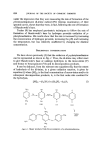
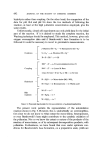
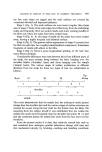
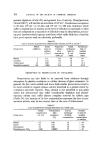
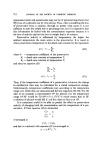
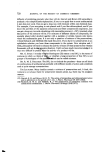
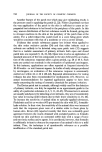
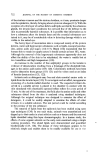
692 JOURNAL OF THE SOCIETY OF COSMETIC CHEMISTS hydrolysis rather than coupling. On the other hand, the comparison of the data for pH 10.4 and pH 9.6 show the two methods of following the reaction, at least at the high p-diamine concentration employed, give the same results. Unfortunately, closed cell experiments can only yield data for the initial part of the reaction. If it is desired to study the complete reaction, the Warburg technique should be employed. This method, however, gives only oxygen consumption data and if Bandrowski's base formation is to be followed it would be necessary to resort to gravimetric measurements. Oxidation Coupling Hydrolysis Side reactions p-Diamine (P)+O• Semiquinone (S) S+O•.- Di-imine (D)+Oo•= D+P+2H + • 2S DH + +P ----- Tri-aminodiphenylamine (T) DH + +T ----- Leuco B. Base Leuco B. base+D (or O 2 or M) -----B. base D +H20 ---- Mono-imine (M) +NH a M +H20 ----- Benzoquinone ----- Humic acid M+P--O- ? D + H20z --O- ? M+H20•. ----- ? Figure 9. Proposed mechanism for the autoxidation ofp-phenylenediamine The present work permits the representation of the autoxidation reaction shown in Fig. 9. However, this is undoubtedly an oversimplifica- tion since we do not know to what extent the mono-imine, benzoquinone, or even Bandrowski's base might contribute to the catalytic oxidation of the p-diamine. Nor so we know the extent or nature of the products of the reaction of mono-imine, or of its subsequent decomposition products, with p-diamine. Furthermore, we have found that even under optimum con- ditions for Bandrowski's base formation, on a preparative scale, yields are
Purchased for the exclusive use of nofirst nolast (unknown)
From: SCC Media Library & Resource Center (library.scconline.org)