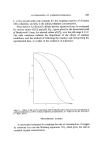
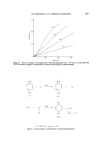
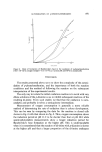
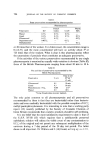
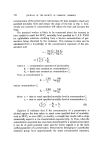
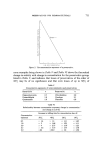
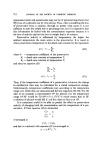
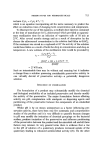
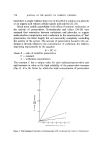
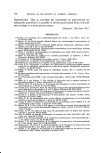
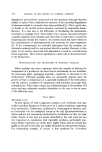
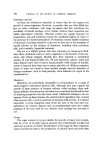
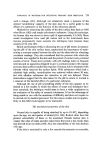
AUTOXlDATION OF •O-PHENYLENEDIAMINE 689 2O i I I 25 50 75 [trne (min) Figure 6. First order rate plots for oxygen consumption in solutions of p-phenylenediamine (10.0X 10-aM) in closed cells at pH 10.4 and 30øC. If di-imine were not consumed by other reactions, a simple kinetic pattern might emerge. However, di-imine is consumed by hydrolysis and in the formation of Bandrowski's base. SPECTROSCOPIC TECHNIQUES We have shown previously (5) that by using very dilute (0.1 x 10-a•d) solutions of the p-diamine, its oxidation to di-imine can be followed spectrophotometrically. Such studies showed that the rate of formation of di-imine, subsequent to an induction period, increased with increasing pH over the range 8.50-11.20. Further studies have now shown that the dura- tion of the induction period decreases as oxygen concentration increases while the rate of the subsequent reaction is independent of oxygen con- centration. Similarly, provided the reaction conditions are such that Bandrowski's base is not formed, the duration of the induction period is decreased as the initial p-diamine concentration is increased. These results again point to an autocatalytic mechanism involving the semiquinone. We have also studied the early stages of the oxidation of p-diamine (0.01 M) by bubbling air or pure oxygen through the solution and

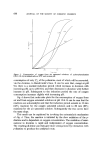
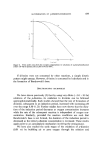
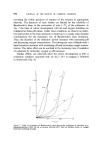
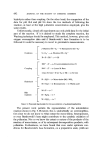
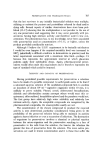
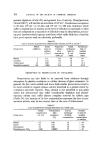
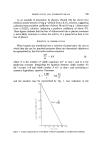
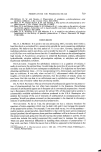
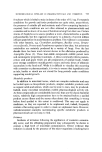
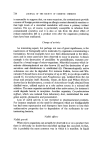
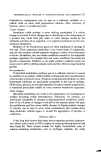
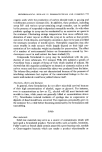
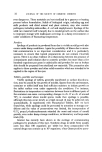
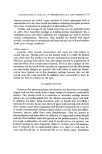
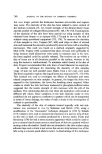
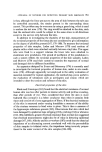
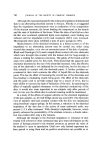
690 JOURNAL OF THE SOCIETY OF COSMETIC CHEMISTS recording the visible spectrum of samples of the solution at appropriate intervals. The duration of such studies are limited by the solubility of Bandrowski's base, to the conversion of only 1-2}/0 of the p-diamine. In Fig. 7 the rates of colour development with air and oxygen bubbling are compared at three pH values. Under these conditions we observe an induc- tion period due to the time necessary to build up to a steady state di-imine concentration for the maximum rate of Bandrowski's base formation. Thus, the duration of the induction period increases with increasing pH and decreasing oxygen concentration. The subsequent rate of Bandrowski's base formation increases with increasing pH and increasing oxygen concen- tration. This latter effect can be ascribed to the increasing rate ot• oxidation of p-diamine by molecular oxygen as pH increases. Similar effects are observed when the colour development in 0.01 M p-diamine solutions saturated with air (0.2 x 10 -a M oxygen) is followed in closed cells (Fig. 8). 0.75 II 4 0.50 0,25 9 85 O7 25 50 75 Time (mn) Figure 7. Rate of formation of Bandrowski's base during the oxidation of solutions of •o- phenylenediamine (10.0x 10-aM) at various pH and 30øC with air (broken lines) or oxygen (full lines) bubbling through.
Purchased for the exclusive use of nofirst nolast (unknown)
From: SCC Media Library & Resource Center (library.scconline.org)