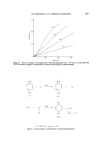
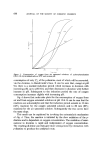
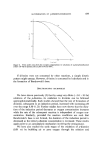
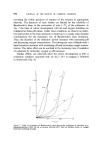
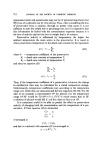
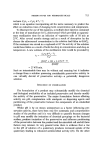
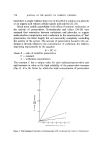
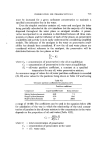
AUTOXIDATION OF D-PHENYLENEDIAMINE 693 invariably less than 80•o. This is evidently due to side reactions such as the formation of nitroaniline and di-amino-azobenzenes, and also to degrada- tion by hydrogen peroxide giving rise to ammonia and low molecular weight carboxylic acids. This latter would explain the even lower yields of Bandrowski's base reported for the oxidation of p-diamine by hydrogen peroxide (2, 4). It must be concluded that the system is too complex to permit quantita- tive analysis. In the present work we have attempted to explain experimental observations in terms of the minimum number of interactions. ACKNOWLEDGMENT The author thanks Messrs. G. W. Amery, A. G. Fooks and R. W. B. Hopkins for assistance with the experimental work. (Received: $1st May 1,972) REFERENCES (1) Bandrowski, E. Ueber die Oxidation des Paraphenyelendiamins. Bet. 27 480 (1894). (2) Heiduschka, A. and Goldstein, E. Ueber das Oxidationsprodukt des p-Phenylenediamins mit Wasserstoffsuperoxyd. Arch. Pharm. 254 584 (1916). (3) Erdmann, E. Oxidationprodukte des p-Phenylenediamins. Bet. 37 1906 (1904). (4) Altman, M. and Rieger, M. M. The function of Bandrowski's base in hair dyeing. J. Soc. Cosmet. Chem. 19 141 (1968). Corbett, J. F. Benzoquinone imines, Part III. J. $oc. Dyers Colour. 85 71 (1969). (5) Corbett, J. F. Benzoquinone didmine, a vital intermediate in oxidative hair dyeing. J. Soc. Cosmet. Chem. 20 253 (1969). (6) Corbett, J. F. Benzoquinone imines, Part IV. J. Chem. Soc. B. 818 (1969). (7) Lu Valle, J. E., Glass, D. B. and Weissberger, A. Oxidation processes XXI. J. Amer. Chem. Soc. 70 2223 (1948). (8) Cilento, G. and Zinner, K. Oxygen activation, Part III. Blochim. Biophys. Acta 143 93 (1967). (9) Tucker, H. H. Hair coloring with oxidation dye intermediates. J. $oc. Cosmet. Chem. 18 609 (1967). (10 Corbett, J. F. Benzoquinone imines, Part II. J. Chem. Soc. B 213 (1969). (11) Dixon, M. Manometric methods 7 (1952) (Cambridge University Press, London). (12) Corbett, J. F. Intermediates and products in oxidative hair dyeing. Proc. Joint Conf. Cosmet. $ci. Washington D.C. (Toilet Good Assoc.) 159 (1968). (13) Corbett, J. F. Benzoquinone imines, Part I. J. Chem. Soc. B 208 (1969). (14) Clark, L. C., Jr. Monitor and control of blood and tissue oxygen tension. Trans. Amer. Soc. Artif. Intern. Organs 2 41 (1956).

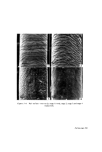
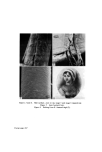
J. Soc. Cosmet. Chem. 23 695-702 (1972) ¸ 1972 Society of Cosmetic Chemists of Great Britain The critical determination of fine changes in the surface architecture of human hair due to cosmetic treatment J. A. SWIFT and A. C. BROWN* Presented on 12th September 1972 at the 7th IFSCC Congress, in Hamburg, Germany. Synopsis--The SURFACE of normal human HAIR and of hair which has been COMBED, BACK-COMBED, PERMED, BLEACHED and treated with a POLYMER has been examined in detail using some new techniques for the SCANNING ELECTRON MICRO- SCOPE. Minute changes in the hair surface have been detected and for many of the treatments it is clear that the SCALE edges gradually chip away. In addition some interesting observations are reported of JANE AUSTEN's hair. INTRODUCTION The effects of toiletry treatments on human hair are largely visual and tactile and as such are intimately related to the surface architecture of the individual fibres. The scanning electron microscope is a powerful tool for studying fibre surfaces and for determining the effects of various toiletry treatments on them. Unfortunately there is such wide variability in the fine detailed surface structure from one hair to another, and indeed along the length of a single hair, that it has only so far been possible to determine with any certainty gross changes in surface structure due to toiletry treat- ments. Thus, it has only been possible to identify surface changes such as those due to the application of hair sprays, overperming, bleaching or the removal of thick dirt deposits with shampoos (1). *Unilever Research Laboratory, 455 London Road, Isleworth, Middlesex. 695
Purchased for the exclusive use of nofirst nolast (unknown)
From: SCC Media Library & Resource Center (library.scconline.org)