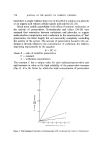
760 JOURNAL OF THE SOCIETY OF COSMETIC CHEMISTS but over longer periods the distension becomes irreversible and rupture may occur. The elasticity of the skin has been related to water content of the stratum corneum (13, 11), tensile strength of the dermal elastic tissue and the number of collagen fibres present (167, 168, 170-172). Examinations of the elasticity of the skin have been carried out using samples of skin obtained from biopsy or at autopsy (168, 171) and in vivo on the skin of subjects using specialized equipment (173, 174). To measure the elasticity of skin samples in vitro, Tregear (167, 168) used strips or discs of excised skin and measured the extension produced by known forces with a travelling microscope. This work was based on a method originally suggested by Dick (170). Tregear (168) considered that discs of tissue were preferable to strips because small distensions were easier to measure and, in his view, the force applied could be quickly released. The tensions set up within a disc of tissue are in all directions parallel to the surface, whereas in the strip the tension is unidirectional. To minimize radial stretch in the disc of skin, Tregear recommended that only discs of small diameter be employed. In another technique for measuring the elasticity of skin samples, 'rings' of skin cut with parallel razor blades from a rat's tail, were used. The force required to rupture the ring of tissue was measured (171,175-176). This method was used to investigate the effects of hydrazine and some related compounds on skin samples. In general, the longer the skins were exposed to the hydrazines, the lower the breaking strain required. Other studies in which the skin had been immersed in phosphate-buffered saline suggested that the tensile strength of skin increases with the pH of the medium. This relationship did not exist when the hydrazines were tested at different pH values. Since variations in the skin elasticity under in vitro conditions do not appear to conform to a pattern which can be interpreted in terms of tissue damage, the value of such a study in the investigation of irritants is questionable. The elasticity of the skin of subjects treated topically with test sub- stances was examined in vivo by Sodeman and Burch (173), using a modification of the 'elastometer' technique designed in 1912 by Schade (177). Calipers were used to measure the extension of a narrow strip of skin on the arm or back of a patient produced by a known strain. Evans and Seisennop (174) devised a more accurate apparatus which could be used to give a uniaxial tensile strain across a small area of skin on a patient without causing undue discomfort. Small tabs are attached to the skin surface using adhesive tape and a strain is put across the narrow strip between two of the tabs using a constant speed electric motor. A disadvantage of this technique

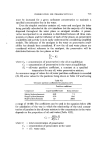
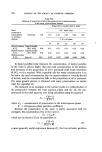
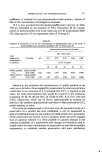
APPRAISAL OF METHODS FOR DETECTING PRIMARY SKIN IRRITANTS 761 is that, although the force put across the area of skin between the tabs can be controlled accurately, the strains present in the surrounding tissue cannot. This problem may be overcome by using a guard ring, which is used to enclose the test area (178). The ring would be attached to the skin, such that the enclosed skin would be subject to the same stress in all directions except in the narrow strip between the tabs. In addition to investigating the elasticity of the skin, measurements of the torsional properties of the tissue also are considered to give information on the degree of pliability present (167, 178-180). To measure the torsional properties of skin samples, Laden and Morrow (179) used sections of plantar callus which were attached vertically between vinyl tabs. The upper tabs were fixed to a support whereas the lower tabs were attached to aluminium wire pendulums. The period of oscillation of the pendulums in such a system reflects the torsional properties of the skin samples. Laden and Morrow (179) used their system to examine the responses of normal and damaged skin to different humidifies. An apparatus designed by Evans and Seisennop (174) is currently used to investigate the torsional properties of human skin, under in vivo condi- tions (178). Although apparently not employed in the safety evaluation of materials intended for topical application, the method may prove useful in the evaluation of substances such as astringents and creams which are intended to alter the tension and softness of the skin. Electrical properties of the skin Blank and Finesinger (181) found that the electrical resistance of normal human skin was less after periods in intense activity and profuse sweating, than after periods of rest. They considered that when the skin is more hydrated than normal it is a better conductor than when it contains little water and consists of a loose aggregation of fibres. If the electrical resistance of the skin is measured under varying humidities a measure of the ability of the stratum corneum to bind water is given. This is then a measure of the hygroscopic substances present (182). Observations that skin which had been damaged by epidermal tape stripping (183), pricking (184) or abrasion (185, 186) exhibited a greater electrical resistance than normal skin suggested that electrical measurements might also be of value in detecting epidermal damage (167, 168). Allenby and his co-workers (187) noted that the electrical impedance of an alternating current correlated well with the permeability of skin samples to tritiated water, the impedance being inversely propor- tional to the water content of the skin samples (188-190).
Purchased for the exclusive use of nofirst nolast (unknown)
From: SCC Media Library & Resource Center (library.scconline.org)