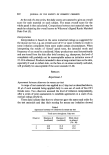
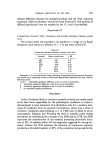
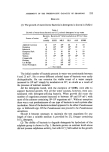
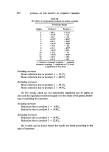
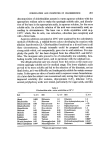
PRIMARY IRRITATION OF THE SKIN 225 nificant difference between the standard product and the other materials examined, whilst the Student t test showed that Formula II with perfume D differed significantly from the standard at the 5•o level of probability. Experiment IV Comparisons between 'baby' shampoos and normal shampoos (hmnan patch test) The human patch test procedure was applied to a range of six liquid shampoos, each tested at a dilution of 1: 5 in tap water (Table III). Table III Comparison between shampoos (human patch test) Formula Mean overall score 4- SE Aõll 8.81 0.47 B•[ I 9.02 0.41 c*•ll 9.94 0.52 D* 12.57 0.90 E'• 23.67 1.53 F•' 28.70 1.12 Shampoos A-D were described as 'baby' shampoos. Comparison between pairs of shampoos was carried out by subjecting the data to Wilcoxon's Signed Ranks Matched Pairs Test, with the following results: * and •' statistically significant difference at the 1 • level of probability + statistically significant difference at the 2 % level of probability + õ statistically significant difference at the 5 • level of probability ]l no statistically significant difference. DISCUSSION Levels of irritancy likely to concern a cosmetic scientist are usually much lower than those responsible for the pathological conditions in which a dermatologist is most interested. This distinction calls for a sensitive tech- nique for predictive tests on cosmetic formulations, where even a level of consumer complaints approximating to 1 in 5 000 users is likely to prove unacceptable. Kligman and Wooding (4) tried to quantify patch testing procedures by introducing the concepts of an ID50 and an IT50 the ID50 represents the concentration of test material producing discernible irrita- tion in 50•o of subjects within 24 h (an approach suggested for strong irri- tants), whereas the IT50 estimates the duration of continuous exposure producing a threshold reaction in 50• of the population (proposed for the

226 JOURNAL OF THE SOCIETY OF COSMETIC CHEMISTS study of weak irritants). Most cosmetics would not be sufficiently irritant to give a clear response in the ID50 test and the principle of varying the concentration is often inappropriate. The principle of an IT50 is undoubted- ly applicable in many respects but continuous exposure of the skin to a potential irritant, as in the test defined by Kligrnan and Wooding, is only justifiable in our opinion when patch testing is carried out under direct medical supervision. The intermittent exposure which is a feature of the Finkelstein et al (2) technique reduces the risk of serious discomfort or skin damage and does not require volunteers to wear unsightly patches or to refrain from taking baths in off-duty hours. We have therefore based our procedure on that of Finkelstein et al (2), modified in the light of experience, notably with some of the newer surgical tapes. Nevertheless improved statistical validity might be achieved by adopting the IT50 approach in the intermittent patch test procedure, though we doubt whether an irritancy assessment based on time of exposure yields as much pertinent information as an assessment of the degree or severity of response. With new cosmetic ingredients, laboratory animal studies should in- variably be carried out before they are tested on human skin even with well-known raw materials, it is prudent to screen new formulations simi- larly. The advisability of proceeding cautiously in this way is emphasized by the fact that 'closed' patch testing on human skin tends to exaggerate the response and introduces a distinct risk of severe reactions even with some formulations that would be virtually non-irritant in normal 'open' usage. Many shampoos applied in concentrated form under a 'closed' patch (even in the intermittent patch testing procedure) cause blistering of the skin before completion of a 5 day test. Obviously such a reaction has little or no predictive value in terms of normal usage and the test procedure must therefore be adapted in accordance with the type of formulation under investigation for example, shampoos are preferably tested at 10-20•o aqueous dilution. Since the appropriate conditions for human patch testing may not be known before the studies begin, it is clearly essential to conduct screening on laboratory animals as a preliminary. Considerable experience in using the mouse ear test has given us a good deal of confidence in its predictive value. However, irritancy tests should preferably be conducted on at least two different species and we now use both the mouse ear and rabbit flank as testing sites routinely. The ability to run a large number of tests in a relatively limited space is a distinct advan- tage for the mouse ear test. Another useful application for the test has been for examining complaint samples of various cosmetics, the test being
Purchased for the exclusive use of nofirst nolast (unknown)
From: SCC Media Library & Resource Center (library.scconline.org)