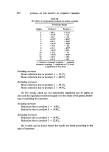
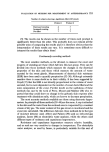
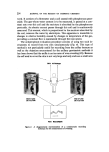
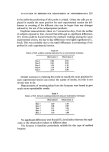
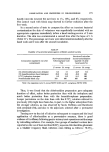
256 JOURNAL OF THE SOCIETY OF COSMETIC CHEMISTS (a) The even distribution of glands means that the positioning of the cell on the skin is not so critical (see Table V). (b) The reflexes affecting sweating unilaterally are not so pronounced in the forearms, or can be avoided completely by using two sites on the same forearm. CONCLUSIONS There are many methods available to the cosmetic chemist to measure the effectiveness of antiperspirants (both active materials and prototype products) for guidance during development work and to provide technical support for the marketed products. It is however important that the scientist has a thorough understanding of both the physiological and chemical principles behind the methods he is using so as to avoid the pitfalls asso- ciated with each type of experiment. In the case of the colorimetric methods he may get apparently very good sweat inhibition if the antiperspirant material interferes with the colour formation. This may lead to much wasted time in developing a product which has no effect at all against eccrine sweating. With the methods in which sweating is measured from the axillae the results tend to be so variable, and they are so difficult to interpret from small panel tests that large numbers of subjects are needed before meaningful con- clusions on the population as a whole can be drawn. The most accurate measurement can be taken from areas other than the axillae, e.g. the forearm using the sensitive continuously recording methods. These results however are always open to the criticism that the area where the material was tested does not behave in the same manner as the axillae, the areas where the products are to be used. There are, therefore, many methods available to measure the effects of antiperspirants, but care should be taken not only in obtaining the measure- ments but also with the interpretation placed on these results, otherwise the wrong conclusions can be drawn from otherwise sound observations. (Received: 11th February 1972) REFERENCES (1) Green, J.P. Statistical review of the aerosol industry up to 1970. Aerosol Rep. 10 565 (1971). (2) Rubino, A.M. Aerosol antiperspirants in the U.S.A. Aerosol Rep. 10 647 (1971). (3) Hurley, H. J. and Shelley, W.B. The human apocrine glan• in health and disease (1960) (Thomas, Springfield, Ill.). (4) Kuno, Y. Human perspiration (1956) (Thomas, Springfield, Ill.).

EVALUATION OF METHODS FOR MEASUREMENT OF ANTIPERSPIRANGY 257 (5) Ogata, K. J. Orient Med. 25 1613 (1936). (6) Herrmann, F., Prose, P.H. and Sulzberger, M. B. Studies on sweating. V. Studies of quan- tity and distribution of thermogenlc sweat delivery to the skin. J. Invest. Dermatol. 18 71 (1952). (7) Johnson, C. and Shuster, S. The patency of sweat ducts in normal looking skin. Brit. J. DermatoL 83 367 (1970). (8) Govette, T. and de Navarre, M. G. Aluminium chlorhydrate: a new antiperspirant ingredient. ,'liner. Perfum. 49 365 (1947). (9) Sivadjian, J., Vautrin, M. and Vautrin-Matge, H. Action Anidrotique local compar6e de deux Anticholinergique. Thetapie 22 1015 (1967). (10) Richter, C. P. and Whelan, F. Sweat gland responses to sympathetic stimulation studied by the galvanic skin reflex method. J. NeurophysioL 6 191 (1943). (11) Alphin, R. S., Saunders, D. and Ward, J. W. Method for the evaluation of antihidrotic substances in the anaesthetized cat. J. Pharm. Sci. $6 449 (1967). (12) Minor, V. Eines Neues Vorfahren zur der klinischen Untersuchung der Schweissabans- derung. Deut. Z. Nervenh. 101 302 (1927). (13) Roth, G. M. A clinical test for sweating. Proc. Staff Meet. Mayo Clin. 10 383 (1935). (14) List, C. F. and Peet, M. Sweat secretion in man. I. Sweating responses in normal persons. Arch. Neut. Psychiat. 39 1228 (1938). (15) Guttmann, L. Topographic studies of disturbances of sweat secretion after complete lesions of peripheral nerves. J. Neurol. Psychiat. :5 197 (1940). (16) Silverman, J. J. and Powell, V. E. Studies on palmar sweating. ,'liner. J. Med. Sci. 208 297 (1944). (17) Randall, W. C. Quantitation and regional distribution of sweat glands in man. J. Clin. Invest. 25 761 (1946). (18) Wada, M. and Takagaki, T. Tohoku J. Exp. Med. 49 284 (1947). (19) Tashiro, G., Wada, M. and Sakurai, M. A bromophenol blue method for visualizing sweat at the openings of the sweat ducts. J. Invest. DermatoL 36 3 (1961). (20) Papa, M. C. and Kligman, A.M. Modification of the Wada method for visualizing and recording eccrine sweating. J. Invest. Dermatol. 36 167 (1961). (21) Papa, M. C. A new technique to observe and record sweating. Arch. Derrnatol. 88 732 (1963). (22) Juhlin, L. and Shelley, W. B. A stain for sweat pores. Nature, Lond. 213 408 (1967). (23) Sarkany, I. and Gaylarde, P. A method for demonstration of sweat gland activity. Brit. J. Derrnatol. 80 601 (1968). (24) Wooding, W. M. Jass, H. E. and Ugelow, I. Statistical evaluation of quantitative anti- perspirant data. J. Soc. Cosmet. Chern. 15 579 (1964). (25) Randall, W. C. and McClure, W. Quantitation of the output of individual sweat glands and their response to stimulation. J..dppl. PhysioL 2 72 (1949). (26) McDowell, R. E., Lee, D. H. K. and Fohrman, M. H. The measurement of water evapora- tion from limited areas of a normal body surface. J. ,,lnim. Sci. 13 405 (1954). (27) Fredell, W. G. and Read, R. R. Antiperspirants--Axillary method of determining effective- ness. Proc. Sci. Sect. Toilet Goods Ass. 15 23 (1951). (28) Fredell, W. G. and Longfellow, J. Evaluating antiperspirants and deodorant products. J. Soc. Cosmet. Chem. 9 108 (1958). (29) Daley, D. W. Antiperspirant testing. A comparison of two methods. Proc. Sci. Sect. Toilet Goods Ass. 30 1 (1958). (30) Wooding, W. M. Interpretation of gravimetric axillary antiperspirant data. Proc. Joint Conf. Cosmet. ScL (1968). (31) Cohen, M. E. Studies on the palmar hand sweat in healthy subjects and in patienta with neuro-circulatory asthenia (anxiety neurosis, neurasthemia, effort syndrome) with descrip- tion of a simple quantitative method./liner. J. Med. Sci. 220 469 (1950).
Purchased for the exclusive use of nofirst nolast (unknown)
From: SCC Media Library & Resource Center (library.scconline.org)