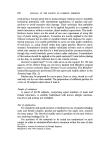
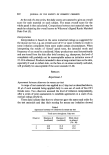
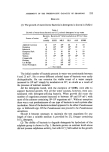
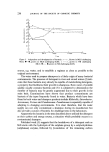
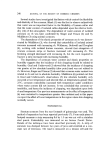
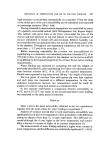
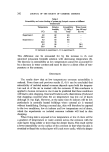
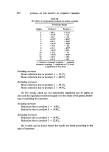
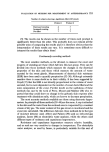
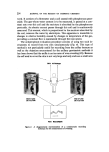
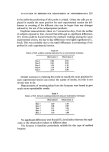
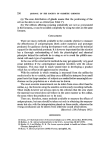
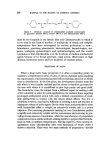
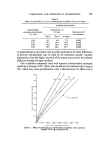
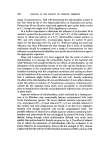
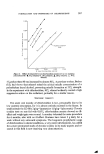
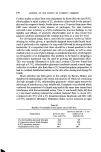
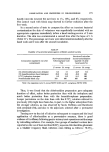
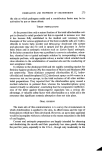
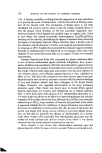
242 JOURNAL OF THE SOCIETY OF COSMETIC CHEMISTS Table I Extensibility and water binding of guinea-pig footpad corneum at different temperatures Temperature Relative Extensibility Water bound humidity (% 100 g-X (mg 100 (øC) ( • load) dry wO Experiment 1 Experiraent 2 4.8 69 4.6 - 18.9 62 6.3 - 4.0 80 0.8 - 22.0 58 1.3 - 4.0 86 - 26.1 22.0 81 - 20.6 12 replicates in experiment 1, 11 in experiment 2. This difference can be accounted for by the increase in rh over saturated potassium bromide solution with decreasing temperature (8). The decrease in extensibility at low temperature cannot be accounted for by a decrease in water content and must be due to a direct effect of tem- perature on the corneum. DISCUSSION The results show that at low temperatures corneum extensibility is reduced. From these and previous results (3, 6) it can be concluded that extensibility of isolated animal corneum depends upon both the tempera- ture and rh of the air in contact with the corneum. If this conclusion is applied to human corneum in vivo it can be predicted that these conditions will lead to skin chapping. Gaul and Underwood's observations (5) showed that chapping occurred when the air temperature was low out of doors although rh was high. However, at the same time rh indoors will be low particularly in centrally heated buildings where external air is warmed without humidifying. During a normal day, skin will therefore be exposed to the two conditions, low rh indoors and low temperature out of doors, which the experiments on isolated corneum indicate will lead to skin chapping. When living skin is exposed to low temperature or low rh there will be a gradient of temperature or water content across the corneum with the outer layers being colder or drier than the deeper layers. The result will be a lower extensibility on the surface of the corneum so that when the skin is stretched or flexed the surface layers will crack more easily, while the deeper

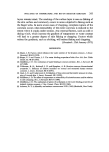
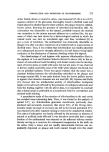
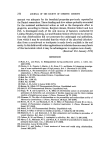
INFLUENCE OF TEMPERATURE AND RH ON STRATUM C:ORNEUM 243 layers remain intact. The cracking of the surface layer is seen as flaking of the skin surface and commonly occurs in areas subjected to flexing such as the finger webs. In more severe cases of chapping, complete rupture of the corneum occurs when extensibility of the entire comeurn is reduced to the extent where it cracks under tension. Any external factors, such as cold or drying winds, which increase the gradient of temperature or water content will lead to a greater degree of skin flaking or chapping. Factors which reduce the gradients, such as clothing, will reduce flaking and chapping. (Received: 12th January 1972) REFERENCES (1) Blank, I. H. Factors which influence the water content of the stratum corneum. J. Invest. Dermatol. 18 433 (1952). (2) Singer, E. J. and Vinson, L. J. The water binding properties of skin. Proe. Sei. Sect. Toilet Goods Ass. 46 29 (1966). (3) Middleton, J. D. The mechanism of water binding in stratum corncure. Brit. d. DermatoL 80 437 (968). (4) Wildnauer, R. H., Bothwell, J. W. and Douglass, A. B. Stratum corneum biomechanical properties. I. Influence of relative humidity on normal and extracted human stratum corneum. J. Invest. DermatoL 56 72 (1971). (5) Gaul, L. E. and Underwood, G. B. Relation of dew point and barometric pressure to chap- ping of normal skin. J. Invest. Dermatol. 19 9 (1952). (6) Middleton, J. D. The effect of temperature on extensiblity of isolated corneum and its relation to skin chapping. Brit. J. Dermatol. 81 717 (1969). (7) Middleton, J. D. The mechanism of action of surfactants on the water binding properties of isolated stratum corneum. J. $oe. Cosmet. Chem. 20 399 (1969). (8) Acheson, D. T. in Humidity and moisture measurement 3 521 (1965) (Reinhold, New York).
Purchased for the exclusive use of nofirst nolast (unknown)
From: SCC Media Library & Resource Center (library.scconline.org)