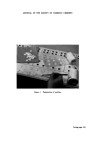
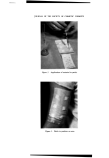
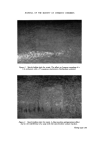
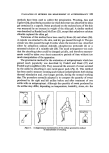
PRIMARY IRRITATION OF THE SKIN 227 used to compare the suspect preparation with a standard specimen of the same product. This is specially helpful when only a minute quantity of the complaint sample is available. We have also attempted to use the mouse ear for detection of sensitizing potential by making 'challenge' applications 10-14 days after the usual series of applications. Our experience is inade- quate, however, to indicate whether this has reliable predictive value. Excision and sectioning of the mouse ear after sacrifice may be carried out to obtain confirmation of oedematous changes due to irritation. Using the cartilage of the ear as a datum position, a semi-quantitative estimate of irritancy may thereby be derived. ACKNOWLEDGMENTS We should like to thank Mr D. B. Jones for his assistance in this work, and Mr H. Ashmore for the photographs. (Received: 9th February 1972) REFERENCES (1) Brown, D. M. and Robson, R. D. Nature, Lond. 202 812 (1964). (2) Finkelstein, P., Laden, K. and Miechowski, W. J. Invest. Dermatol. 40 11 (1963). (3) Siegal, S. Nonparametric statistics for the behavioural sciences (1956) (McGraw-Hill Book Co., London). (4) Kligman, A.M. and Wooding, W. M. J. Invest. DermatoL 49 78 (1967).

J. Soc. Cosmet. Chem. 24 229-238 (1973) ¸ 1973 Society of Cosmetic Chemis• •f Great Britain Assessment of the preservative capacity of shampoos PHYLLIS C. FLAWN, S. A. MALCOLM and R. C. S. WOODROFFE* Based on a lecture delivered on the 29th September 1971 in London, at the Symposium on 'Microbial Control', organized by the Pharmaceutical Society of Great Britain and the Society of Cosmetic Chemists of Great Britain. Synopsis--Some factors involved in the development of a TEST for PRESERVATIVE CAPA- CITY (challenge test) for SHAMPOOS are discussed. A microbiological survey of public WATER supplies revealed the presence of Gram-negative bacteria, including PSEUDOMONAS sp capable of utilizing ANIONIC DETERGENTS as a sole carbon and sulphur source by virtue of their inducible SULPHATASE ENZYMES. Tap water ttterefore provides a suitable source of challenge test bacteria which may be isolated on Ionagar containing 0.1% detergent. The amount of slime produced by these organisms is increased during growth in detergent. Utilizing these data, a challenge test for shampoos is described. INTRODUCTION Toilet products, as is well known, may contain micro-organisms. Therefore, it is necessary that they should be adequately preserved. Some products are completely preserved by the formulation and do not require added preservative. Yet others are in a specific and therefore only partially effective state of preservation. In these cases some micro-organisms are completely inhibited while others may multiply in the product. The inclusion of antimicrobial agents as preservatives in products is an attempt to shift the preservation type from specific to non-specific. There- fore, any test to challenge preservative capacity must be designed to deter- * Unilever Research Laboratory, 455 London Road, Isleworth, Middlesex. 229
Purchased for the exclusive use of nofirst nolast (unknown)
From: SCC Media Library & Resource Center (library.scconline.org)