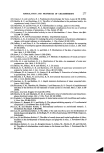
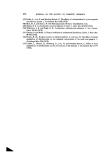
238 JOURNAL OF THE SOCIETY OF COSMETIC CHEMISTS batches of raw materials, especially detergents. Three separate samples of SLES provided by the same supplier gave three different results in a challenge test. Further investigation showed that one contained mercurials, one formalin and the other no preservative. It is clear that a challenge test on a product containing the preserved detergent would indicate that the formula- tion was self-preserving. The same formulation, prepared in the factory with unpreserved detergent, would soon become contaminated, and the laboratory challenge test would fall into disrepute. It is essential that the bacteria used in a microbiological challenge test for shampoos are given every opportunity to survive in the absence of a preservative so that the preservative system added subsequently is really put to the test. This being the case, the most important aspect of a challenge test is the choice bf the correct organisms: tap water provides a supply. This removes the need for maintaining bacteria on enriched media which could bring about metabolic or morphological changes, and it simulates actual contamination as it can occur in the factory. Special pretreatment of the bacteria before inoculating into a shampoo is not essential, except perhaps training them to withstand high levels of detergents. With some variables still remaining, the challenge test can still only give a guide to the likelihood of contamination in a product, though a much better guide than before. At a time when shampoos are containing more nutrients, allowing the growth of a much larger variety of organisms than has been found to date, it is essential that the most appropriate and informa- tive test methods be used. (Received: 24th January 1972) REFERENCES (1) Hsu, Y. Detergent-splitting enzyme from t'seudomonas. Nature, Lond. 207 385 (1965). (2) Taylor, E. W. Metropolitan Water Board 43rd Report on the Results of the Bacteriological, Chemical and Biological Examination of the London Water for the Years 1967/1968. (3) Yasufuku, M., Hashimoto, Iq ., Hamai, J. and Uesugi, Y. A biological study of t'seudomonas contaminant in shampoo and its chemical preservation. 5th Cong. Int. Fed. $oc. Cosmet. Chem. (Tokyo, 1968) Reprints 363 (1968).

J. Soc. Cosmet. Chem. 24 239-243 (1973) • 1973 Society of Cosmetic Chemists of Great Britain The influence of temperature and humidity on stratum corneum and its relation to skin chapping J. D. MIDDLETON and B. M. ALLEN* Presented on the 11th April 1972 in Oxford, at the Symposium on' Skin--Environmental responses and protection', organized by the Society of Cosmetic Chemists of Great Britain. Synopsis The susceptibility of the STRATUM CORNEUM to CHAPPING depends upon its mechanical properties such as extensibility. It has previously been shown that at constant temperature, extensibility of isolated corneum is related to RELATIVE HUMIDITY and that at constant relative humidity, extensibility increases when the temperature is raised above 25øC. In this report extensibility of isolated animal corneum has been determined at 5øC where skin chapping occurs more frequently. EXTENSIBILITY was found to be lower at reduced tem- peratures although the corneum water content did not decrease. It was concluded that skin chapping is the result of a low corneum TEMPERATURE and WATER CONTENT and that greater flaking and chapping of the surface corneum is a result of a gradient of temperature or water content across the corneum in a cold or dry ENVIRONMENT. INTRODUCTION The function of the stratum corneum is to protect the underlying tissues from desiccation and from chemical and physical insult. To fulfil these functions it must form a continuous membrane with a high degree of flexibility and elasticity to allow for the movements of the skin. If flexibility and elasticity are reduced the corneum tends to crack and flake. This con- dition is commonly seen, particularly in winter weather, and is often re- ferred to as skin chapping. * Environmental Safety Division, Unilever Research Laboratory Colworth/Welwyn, Colworth House, Shambrook, Bedford. 239
Purchased for the exclusive use of nofirst nolast (unknown)
From: SCC Media Library & Resource Center (library.scconline.org)