240 JOURNAL OF THE SOCIETY OF COSMETIC CHEMISTS Several studies have investigated the factors which control the flexibility and elasticity of the corneum. Blank (1) was the first to observe subjectively that water was an important factor in the flexibility of human callus and that the water content of isolated callus depended upon the relative humi- dity (rh) of the atmosphere. The dependence of water content of isolated corneum on rh was later confirmed by Singer and ¾inson (2) and by Middleton (3) using animal corneum. The dependence of the elastic properties of corneum on rh was demon- strated by Middleton (3), who showed that extensibility of isolated animal corneum increased with increasing rh. Wildnauer, Bothwell and Douglass (4), working with isolated human corneum, showed that elongation of stratum corneum strips at fracture increased with increasing rh. The breaking strength decreased with increasing rh, but the work required to fracture a strip increased with increasing humidity. The dependence of corneum water content and elastic properties on humidity suggests that the incidence of skin chapping should be related to humidity. Gaul and Underwood (5) showed that the incidence of chapping was greater at low absolute humidity (dew point) and was not related to rh. However, Singer and Vinson (2) showed that corneum water content was related to rh and not to absolute humidity. Middleton (6) pointed out that in Gaul and Underwood's observations (5) low absolute humidity only occurred at low temperature and showed that, at temperatures greater than 25øC, corneum extensibility increased with temperature under conditions where water content did not increase. It was concluded that corneum ex- tensibility, and hence the incidence of chapping, was dependent upon both rh and temperature. Our previous measurements on the effect of temperature (6) were restricted to temperatures greater than ambient and in this paper we report the effect of lower temperatures in the region where skin chapping normally occurs. EXPERIMENTAL Stratum corneum from the rear footpads of guinea-pigs was used. The method of separation has been reported previously (7). From each piece of footpad corneum a strip measuring 0.6 by 1.5 cm was cut with a stainless steel punch. Extensibility was measured on an Instron Tensile Tester. Details of the technique have been described previously (3). A strip of corneum was clamped between two pairs of jaws and stretched at a con- stant rate of extension. The load is measured on a tension cell and the

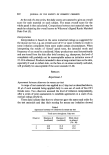
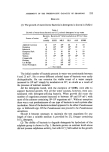
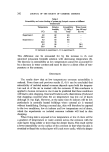
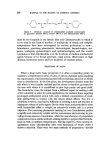
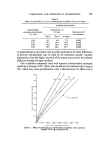
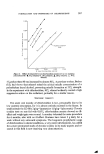
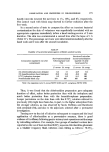
INFLUENCE OF TEMPERATURE AND RH ON STRATUM CORNEUM 241 load-extension curve plotted automatically on a recorder. From the slope of the initial part of the curve extensibility can be calculated and expressed as percentage extension 100 g-• load. During extensibility measurements temperature was controlled by means of a specially constructed cabinet (LEC Refrigeration Ltd, Bognor Regis). This cabinet, with glove holes at the front, surrounded the jaws of the b•stron and had apertures at top and bottom to allow free movement of the jaw attachment to tension cell and crosshead. Relative humidity was not controlled but was measured with a wet and dry bulb thermometer with- in the chamber. Throughout each experiment temperature did not vary by more than -4- 1 øC and rh by more than + 3•o. Before measuring extensibility the corneum was preconditioned by equilibrating in a desiccator over saturated potassium bromide (81• rh at 25øC) for 6 days. It was then placed in the chamber on the Instron and left to equilibrate to the required temperature for at least 20 min before starting measurements. Water binding was measured by comparing wet and dry weights as previously described (3), after equilibrating for 6 days over saturated potas- sium bromide solution (81•o rh at 25øC) at the required temperature. Results were expressed as mg water bound 100 mg -• dry weight of corneum. The two pieces of comeurn from each guinea-pig were kept together and each piece was measured at a different temperature. In this way statistical comparisons between two temperatures could be made by analysis of variance using each animal as a statistical block. In two separate experiments a comparison between extensibility at 4-5øC and at 18-22øC was made. In the second experiment water binding was measured on the same pieces of corneum. RESULTS Table I shows the mean extensibility obtained in the two experiments together with the mean values for water binding in experiment 2. Analysis of variance showed that in both experiments extensibility was significantly less at the lower temperature with a probability of the difference arising by chance of less than 1 •o in each experiment. This difference oc- curred although the rh was higher at the lower temperature and extensi- bility is known to increase at higher rh at constant temperature (3). The measurements of water binding indicated a higher water content at lower temperatures and this difference was statistically significant (P 0.05).
Purchased for the exclusive use of nofirst nolast (unknown)
From: SCC Media Library & Resource Center (library.scconline.org)