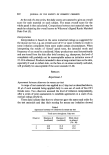
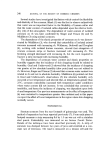
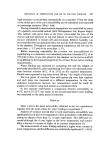
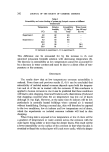
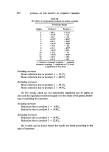
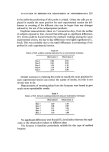
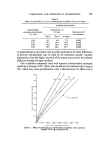
EVALUATION OF METHODS FOR MEASUREMENT OF ANTIPERSPIRANCY 255 in the axilla the positioning of this probe is critical. Unless the cells are re- placed in exactly the same position for each experimental session the dif- ference in sweating of the different sites can be larger than any changes induced by the use of the antiperspirant products. Duplicate measurements, taken on 5 consecutive days, from the axillae of subjects exposed to heat, showed that although no significant differences (5•o level) could be found between the replicate readings during the same experimental session, the day-to-day differences were highly significant (1•o level). This was probably due to the small differences in positioning of the probes for each experimental session. Table IV Ratios of R/L axillary sweating measured by an instrumental technique Observation 1 Observation 2 Day 1 0.62 0.62 Day 2 0.81 0.92 Day 3 1.34 1.18 Day 4 1.36 1.30 Day 5 2.19 1.89 Greater accuracy in replacing the probe in exactly the same position for each experimental session can reduce the scatter of results, but this is not always easy to do. Measurements of sweating taken from the forearms were found to give much more reproducible results. Table V Ratios of R/L forearm sweating measured using an instrumental technique Observation 1 Observation 2 Day 1 1.30 1.01 Day 2 1.06 0.87 Day 3 1.11 1.01 Day 4 1.38 1.17 Day 5 1.19 1.09 No significant differences were found (5% level) either between the repli- cates or the observations taken on different days. The forearm is therefore particularly suitable for this type of method because:

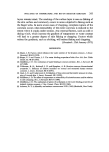
256 JOURNAL OF THE SOCIETY OF COSMETIC CHEMISTS (a) The even distribution of glands means that the positioning of the cell on the skin is not so critical (see Table V). (b) The reflexes affecting sweating unilaterally are not so pronounced in the forearms, or can be avoided completely by using two sites on the same forearm. CONCLUSIONS There are many methods available to the cosmetic chemist to measure the effectiveness of antiperspirants (both active materials and prototype products) for guidance during development work and to provide technical support for the marketed products. It is however important that the scientist has a thorough understanding of both the physiological and chemical principles behind the methods he is using so as to avoid the pitfalls asso- ciated with each type of experiment. In the case of the colorimetric methods he may get apparently very good sweat inhibition if the antiperspirant material interferes with the colour formation. This may lead to much wasted time in developing a product which has no effect at all against eccrine sweating. With the methods in which sweating is measured from the axillae the results tend to be so variable, and they are so difficult to interpret from small panel tests that large numbers of subjects are needed before meaningful con- clusions on the population as a whole can be drawn. The most accurate measurement can be taken from areas other than the axillae, e.g. the forearm using the sensitive continuously recording methods. These results however are always open to the criticism that the area where the material was tested does not behave in the same manner as the axillae, the areas where the products are to be used. There are, therefore, many methods available to measure the effects of antiperspirants, but care should be taken not only in obtaining the measure- ments but also with the interpretation placed on these results, otherwise the wrong conclusions can be drawn from otherwise sound observations. (Received: 11th February 1972) REFERENCES (1) Green, J.P. Statistical review of the aerosol industry up to 1970. Aerosol Rep. 10 565 (1971). (2) Rubino, A.M. Aerosol antiperspirants in the U.S.A. Aerosol Rep. 10 647 (1971). (3) Hurley, H. J. and Shelley, W.B. The human apocrine glan• in health and disease (1960) (Thomas, Springfield, Ill.). (4) Kuno, Y. Human perspiration (1956) (Thomas, Springfield, Ill.).
Purchased for the exclusive use of nofirst nolast (unknown)
From: SCC Media Library & Resource Center (library.scconline.org)