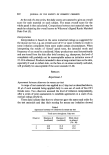
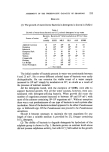
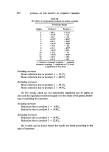
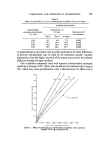
FORMULATION AND PROPERTIES OF CHLORHEXIDINE 261 decomposition of chlorhexidine acetate in warm aqueous solution with the appropriate sodium salts to make the sparingly soluble salts, and dissolu- tion of the base in the appropriate acids, in aqueous solution, for the more soluble salts. An alcoholic solution of the acid was occasionally used, ac- cording to circumstances. The base was a white crystalline solid m.p. 132øC which, like its salts, was colourless, odourless (see exception) and with a bitter taste. Aqueous solutions saturated at 20øC were analysed by the colorimetric method of Holbrook, a reddish-brown colour developing by reaction with alkaline hypobromite (3). Chlorhexidine functioned as a di-acid base in all these circumstances, though tetrasalts could be prepared with certain strong acids which, not unexpectedly, gave rise to acid solutions. For sim- plicity the prefix 'di-' has been dropped from the official B.P. and B.P.C. titles. The inorganic salts proved to be of remarkably low solubility, fore- boding trouble with hard water, and in particular with the sulphate ion. The dihydrochloride salt was chosen from this series as the most con- venient sparingly soluble salt for medical usage. The lower aliphatic acids proved to be more soluble and led to the selection of the diacetate, not an ideal choice, as it was difficultly and inadequately soluble for certain concen- trates. It also gave an odour of acetic acid in aqueous cream formulations. At a later date the subject was re-examined and, noting that hydroxylation improved solubility (for instance, dipropionate 0.4•o, dilactate 1.0•o), several polyhydroxy acids were tested, particularly the sugar adds, and this Table I Chlorhexidine salts--water solubilities at 20 ø C Salt % w/v Salt % w/v Salt % w/v (Base) 0.008 Diformate 1.0 Dilactate 1.0 Dihydriodide 0.1 Diacetate 1.8 Di-o•-hydroxyiosbutyrate 1.3 Dihydrochloride 0.06 Dipropionate 0.4 Digluconate 70 Dihydrofluoride 0.5 Di-i. wbutyrate 1.3 Diglucoheptonate 70 Diperchlorate 0.1 Di-n-valerate 0.7 Dimethanesulphonate 1.2 Dinitrate 0.03 Dicaproate 0.09 Di-isethionate 50 Dinitrite 0.08 Malonate 0.02 Dibenzoate 0.03 Sulphate 0.01 Succinate 0.02 Dicinnamate 0.02* Sulphite 0.02 Malate 0.04 Dimandelate 0.06 Thiosulphate 0.01 Tartrate 0.1 Di-isophthalate 0.008* Di-acid phosphate 0.03 Dimonoglycolate 0.08 Di-2-hydroxynaphthoate 0.014' Difluorophosphate 0.04* Monodiglycolate 2.5 Embonate 0.0009* *These are approximate values.

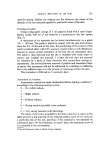
262 JOURNAL OF THE SOCIETY OF COSMETIC CHEMISTS led to the finding that the digluconate (from 1,5-D-gluconolactone in water) was outstanding in conferring extensive solubility (4). A strength of 20• w/v was chosen as the most convenient, concentrations of 40-70• being too viscous and less readily clarified (5). The diglucoheptonate (or di-r- glycero-r-gulo-heptonate) was later found to have closely allied physical properties (6). On similar lines it seemed likely that the fair solubility of the dimethanesulphonate might be improved upon by hydroxylation, i.e. by utilizing the well known solubilizing acid, isethionic acid (2-hydroxyethyl- sulphonic acid), and this surmise proved correct (7). The salt was not intro- duced, however, as it showed no advantage over the digluconate and was more troublesome to make. The outcome of these studies was the introduction of the diacetate (B.P.C.) and dihydrochloride (B.P.) salts, followed by chlorhexidine gluco- nate solution B.P. Acetate and gluconate salts may be used interchangeably in aqueous preparations except in high concentration ( 2•) but the acetate has been almost entirely superseded by the gluconate on grounds of convenience and economy. On the other hand, when the objective is an alcoholic solution of minimum water content the acetate is the better choice. A more recent though minor usage of the acetate is as a preservative for B.P.C. eye drops (0.01•) yet in this context there is no advantage over the more bland gluconate. Sterility is achieved by the process of 'heating with a bactericide', i.e. to a temperature of 98-100øC for 30 min. PROBLEMS WITH INCOMPATIBILITIES There is a widespread belief that the word 'incompatible' bodes complete chemical inactivation and that there should be a strict avoidance of any ingredient to which the term is applied. A study of chlorhexidine formula- tions belies this rule in many instances and is in fact a prime illustration of how so-called incompatibilities may, or may not, be tolerated, modified or circumvented. On the negative side, excess of stearate soap completely in- activates chlorhexidine, even though slight activity is detectable in chlor- hexidine stearate. Likewise, 'insoluble sodium metaphosphate' almost com- pletely binds chlorhexidine in aqueous preparations. The insolubilizing action of inorganic anions, particularly the sulphate, indicates the wisdom of employing purified water, distilled or de-ionized, with manufactured pro- ducts and extemporaneous preparations alike, particularly in the 0.5-1.0•o range, though clear solutions are frequently obtained with reasonably soft water. Nonionic and quaternary surfactants serve to prevent such precipita-
Purchased for the exclusive use of nofirst nolast (unknown)
From: SCC Media Library & Resource Center (library.scconline.org)