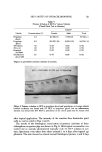
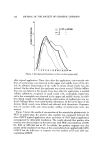
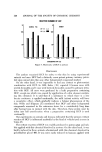
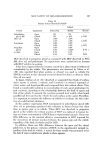
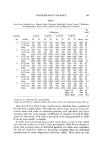
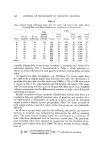
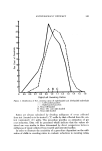
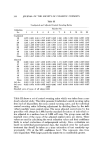
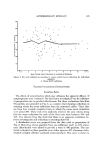
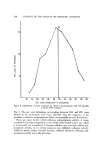
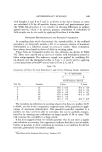
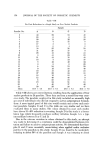
152 JOURNAL OF THE SOCIETY OF COSMETIC CHEMISTS sweating of the panelists during their daily activities? We have accumulated reams of questionnaires, but little usable data, since most of the panelists did not report noticeable sweating during their daily activity. We intend to continue this data accumulation during the forthcoming summer. The limited responses of noticed differences in axillary sweating have shown, in general, less sweating from treated axillae. The data accumulated are not sufficient to comprise a valid statistical analysis. It is contemplated that when a sufficient compilation of data is achieved it will be presented in an additional article. SU1VI•VIARY Portions of data accumulated during the past year in the course of numer- ous antiperspirant efficacy studies were presented. It was demonstrated that: 1. Reductions in sweating are independent of the sweating rate of the panelists. 2. Sweat output from the two axillae is slightly higher from the dominant hand axfila. 3. The response of panelists to antiperspirant activity of effective products follows an essentially normal curve distribution. 4. Evaluations made at 100øF are about the same as those made during ambient conditions. 5. The axillary sweating ratios are much more uniform than are sweating rates when sweat collections are made repeatedly from the same panelist. 6. Sweat reductions are essentially the same when calculations are based on sweating rates and shifts in sweating ratios. Confidence limits of values based on ratios are much narrower than those based on sweating rates. 7. Marked variations are shown in the panelist-to-panelist response to ap- plication of antiperspirant formulations these variations are not uniform from one formulation to another. (Received May 4, 1973) REFERENCES (1) Wada, Masao, Sudorific action of adrenalin on the human sweat glands and determi- nation of their excitability, Science, 111, 376 (1950). (2) Brun, Robert, Studies on perspiration, J. Soc. Cosmet. Chem., 10, 70-7 (1959). (3) Malmo, R. B., Finger-sweat prints in the differentiation of low and high incentive, Psychophysiology, 1, 231-40 (1965). (4) J.ames, R. J., A new and realistic electronic approach to the evaluation of antiperspirant activity, J. Soc. Cosmet. Chem., 17, 749-67 (1966). (5) Jenkins, J. W., Oullette, P. A., Healy, D. J., and Della Lana, Charles, A technique for perspiration measurement, Proc. Sci. Sect. Toilet Goods Ass., 42, 19.-5 (1964). (6) Fredell, W. G., and Read, R. R., Antiperspirants-axillary method of determining effectiveness, Ibid., 15, 23-7 (1951). (7) Daley, E. W., Antiperspirant testing: a comparison of two methods, Ibid., 30, 1-6 (1958). (8) Wooding, W. M., Interpretation of gravimetric axillar antiperspirant data, Proc. Joint Conf. Cosmet. Sci., Washington, D.C., 91-105 (1968).

J. Soc. Cosmet. Chem., 25, 153-158 (March 1974) The Commission of Sin through the Medium of the Skin Patch Test EARLE W. BRAUER, M.D.* Presented May 4, 1973, Seminar, Cincinnati, Ohio Synopsis-The SKIN PATCH TEST is a valuable instrument. In the hands of well- meaning, but misguided, individuals the power of this instrument is creating significant PROBLEMS for MEDICINE in general and for the COSMETIC INDUSTRY in particular. INTRODUCTION In 1900, Jadassohn introduced the concept of the skin patch test (1). In the interim an extensive evolutionary process has produced many variations in technic and scope. A thread of relationship exists among these diverse test procedures occasionally it is obliterated completely. All are performed upon normal or altered skin with the intent of measuring the degree of reactivity of this organ to a test substance offered under a contrived environmental state. The intent of this report is neither to catalogue these many tests nor to dwell on the inestimable contribution each has made to research, medicine, and industry. Instead, the focus of attention will be placed on modes of op- eration in which the patch test may occasionally be the direct or supportive mechanism for disseminating unnecessary confusion in the laboratory, the clinician's office, as well as the market place confusion which may occur innocently enough, and can be avoided. The cosmetic industry is significantly affected by skin patch-test conduct, and therefore a discussion of this subject is opportune. * New York University School of Medicine, New York, N.Y., and Revlon Research Center, Inc., 945 Zerega Ave., Bronx, N.Y. 10473. 153
Purchased for the exclusive use of nofirst nolast (unknown)
From: SCC Media Library & Resource Center (library.scconline.org)