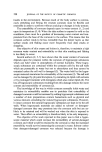
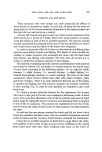
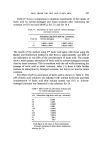
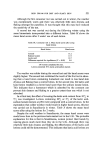
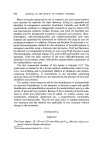
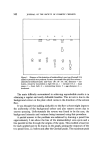
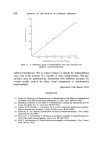
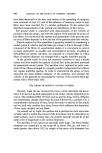
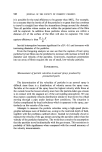
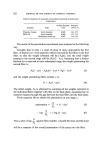
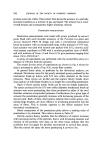
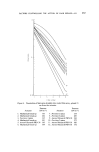
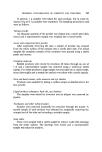
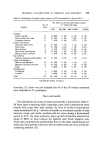
542 JOURNAL OF THE SOCIETY OF COSMETIC CHEMISTS I 2 3 4 5 6 Figure 1. Diagram of the detection of imidazolidinyl urea type (Germall 115) added to personal care products. System: pre-coated silica gel flow solvent = chloroform-methanol-acetic acid-water (50: 30: 10: 10) detection = nin- hydrin, viewed by transmitted uv light 366 rim. 1 = Germall 115 2 = hand cream 3 = foam bath 4 = moisturizing lotion 5 = egg shampoo 6 = deodorant. The main difficulty encountered in achieving reproducible results is in obtaining a regular and easily definable baseline. This in turn is due to the background colour on the plate which varies in the direction of the solvent flow. It was thought that adding ninhydrin to the flow solvent might improve the uniformity of the background colour and also remove errors due to uneven spraying. Unfortunately the reverse was found to be the case, the background intensity and variance being increased using this procedure. A partial answer to the problem was achieved by drawing a pencil line approximately 2 cm above the line of the imidazolidinyl urea spots and a line parallel to this through the origins of the spots. This enabled a base line for each applied spot to be drawn on the graph, joining the responses of the two pencil lines, i.e. before and after the Germall peaks. The maximum peak

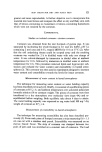
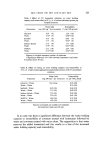
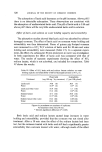
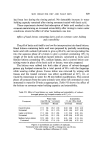
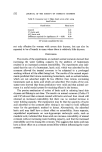
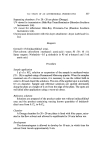
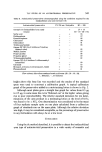
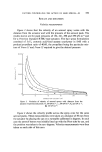
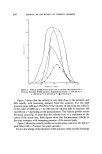
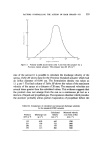
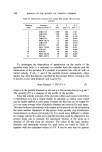
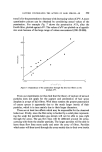
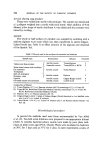
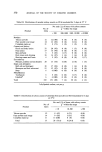
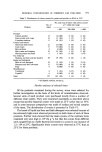
TLC STUDY OF AN ANTIMICROBIAL PRESERVATIVE 543 Table II. Antimicrobial preservatives chromatographed using the conditions required for the imidazolidinyl urea type (Germall 115) Anti-microbial preservative UV 254 nm Ninhydrin Rf x 100 Germall 115 (Imidazolidinyl urea type) -- + 27 + 35 (traces) (0 + 15 + 60 + 72) Sorbic acid -- + 86 Dichlorophene + -- 87 Hexachlorophene + -- 88 Chlorcresol q- -- 90 Chlorxylenol q- -- 91 Trichlorocarbanilide q- -- 88 Irgasan DP 300 (2,4,41-trichloro-2•-hydroxy diphenyl ether) q- -- 92 Methyl paraben + -- 85 Propyl paraben q- -- 88 Propylene glycol -- -- 69 Tribromosalicylanilide + -- 92 Irgasan CF3 (4,4X-dichloro-3-trifluoromethyl - carbanilide) + -- 89 Cetrimide -- + 65 Bronopol, (2-bromo-2-nitropropane-l,3-diol) + -- 80 Phenoxyethanol + -- 91 Flow solvent, chloroform-methanol-acetic acid-water (50: 30: 10: 10). +, Detected --, not detected. height above this base line was recorded and the results of the standard spots were used to construct a calibration graph. A typical calibration graph of the preservative added to a moisturizing lotion is shown in Fig. 2. Although most plates gave a straight line graph for values from 0.5 gg to 2.5 gg, in some cases the curve 'flattened out' at the higher values giving rise to poor reproducibility. The relative standard deviation for ten deter- minations of the urea product in a moisturing lotion at the level of 0.5• was found to be • 10•. One determination was considered to be the mean of four replicate sample spots on one plate calculated from a calibra5on graph of standards run on the same plate. Although the relative deviation was high, it may be Considered acceptable, as the percentage of preservative in any formulation will always be at a low level. CONCLUSION Using the tic method described, it is possible to detect the imidazolidinyl urea type of antimicrobial preservative in a wide variety of cosmetic and
Purchased for the exclusive use of nofirst nolast (unknown)
From: SCC Media Library & Resource Center (library.scconline.org)