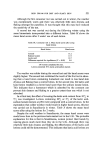
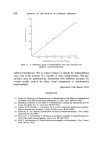
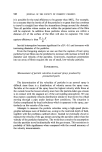
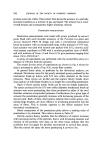
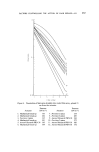
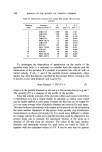
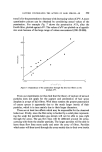
544 JOURNAL OF THE SOCIETY OF COSMETIC CHEMISTS Figure 2. 5O 40 30 •1 I I I I 0'5 1.0 1.5 2 0 2.5 I 3,0 lmidazolidinyl urea (Germoil 115)(p.g) A calibration graph of imidazolidinyl urea type (germall 115) added to a moisturizing lotion. toiletry formulations. The uv colour reaction is specific for imidazolidinyl urea, even in the presence of a number of other antimicrobials. The pre- servative may be quantitatively determined with sufficient accuracy for routine quality control by either visual comparison or densitometric measurements. (Received: 12th March 1974) REFERENCES (1) KOnig, H. Trennung und Identifizierung von Bactericiden auf der Basis von halogenierten Aromaten dutch DQnnschicht-Chromatographie. Z. Anal. Chem. 246 247 (1969). (2) Karleskind, Valmalle, G and Wolff, J.P. Identification et dosage des bact•ricides dans les savons de toilette. Rev. Ft. Corps Gras 19 297 (1972). (3) Graber, M. B., Domsk•, I. I. and Ginn, M. E. A TLC method for identification of germi- cides in personal care products. J. Amer. Oil Chem. Soc. 46 529 (1969). (4) Schwartz, H. Zur Analyse antimikrobiell wirksamer Waschmittelzusfitze. Fette, Seifen, Anstrichm. 71 223 (1969). (5) Porcaro, P. J. and Shubiak, P. Detection of nanogram quantities of hexachlorophene by ultra violet liquid chromatography. Anal. Chem. 44 1865 (1972). (6) Wolf, T. and Semionow, D. Rapid liquid chromatography of bacteriostats. J. Soc. Cosmet. Chem. 24 363 (1973).

J. Soc. Cosmet. Chem. 2• 545-561 (1974) ¸ 1974 Society of Cosmetic Chemists of Great Britain Studies of the factors controlling the action of hair sprays-I i i.' The influence of particle velocity and diameter on the capture of particles by arrays of hair fibres R. W. RANCE*t Synopsis--The VELOCITY of an AEROSOL HAIR SPRAY has been determined by measuring the gas velocity within the spray with a PITOT-STATIC TUBE. The velocity rises to a maximum at the centre of the spray cone and falls rapidly with increasing distance from the spray orifice. For a given distance from the orifice the velocity also falls with decreasing pressure of the aerosol pack. Measurements of CAPTURE and PENETRATION of hair spray droplets into a model ARRAY OF HAIR FIBRES backed by a solid plate representing the scalp have shown that coarse sprays give better penetration than fine sprays. This is in contrast to the behaviour predicted by classical aerosol capture theory and reasons for the observed behaviour are dis- cussed. INTRODUCTION This paper is one of a series which describes studies of the factors influencing the action of hair sprays. Previous papers in this series (1, 2) have been concerned with the events occurring after the hairspray droplets * Unilever Research, Isleworth Laboratory, 455 London Road, Isleworth, Middlesex. ? Present address: Dow Chemical Co. Ltd, European Agricultural Research and Development Centre, King's Lynn, Norfolk. 545
Purchased for the exclusive use of nofirst nolast (unknown)
From: SCC Media Library & Resource Center (library.scconline.org)