546 JOURNAL OF THE SOCIETY OF COSMETIC CHEMISTS have been deposited on the hair, and studies of the spreading of hairspray resin solutions on hair (1), and of the adhesion of hairspray resins to hair fibres have been reported (2). In another publication (3) the author has described measurements of the particle size distribution of hair sprays. The present study is concerned with measurements of the velocity of particles within the sprays, and with the capture of the particles by arrays of hair fibres. It is shown that the capture and penetration of the particles into an array of fibres depends on both the size of the particles and their velocity. Particle capture by fibre assemblies is generally treated by considering a model system in which a partide-laden gas stream is drawn through a filter composed of the fibres. In experimental studies it is convenient to control as many parameters as possible and monodisperse aerosols, travelling at well-defined air-stream velocities, are captured in a model filter in which fibres of uniform diameter are arranged with a regular interfibre spacing. In the present study we have not restricted ourselves to such a model system and have studied the capture of actual hair spray particles produced by pressurized aerosol packs. The particles were captured by grids com- posed of hair fibres arranged in a roughly parallel configuration but without any regular interfibre spacing. In order to characterize the sprays we have measured the mass median diameter of the particles, and assessed the velocity of the particles by measuring the velocity of the partide-laden gas stream with a Pitot-static tube. THE THEORY OF PARTICLE CAPTURE BY FIBRES Recently Light (4) has reviewed the forces which determine the move- ment of an aerosol particle subsequent to the initial velocity imparted by its source. The combined effect of forces such as gravity, drag, inertia, diffusion and electrostatic charges determines the path followed by a particle. For a comprehensive discussion of these forces the reader is referred to this article and we shall only consider here those forces which influence the deposition of hair spray droplets on hair fibres. As pointed out by Light, the particle size is perhaps the most important variable which is within the control of the formulator and for deposition on small surfaces, such as human hair, the particle diameter should be of the same order of magnitude as the surface dimension. The particles in hair sprays are generally quite large. The mass median diameters are commonly in the range 60 to about 300 •tm, and there is rarely greater than about 10•o by weight of the spray with diameters less

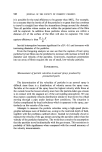
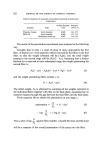
FACTORS CONTROLLING THE ACTION OF HAIR SPRAYS--Ill 547 than 10 •tm. For such large particles the forces aiding capture are mainly gravity, inertia and direct interception. Gravitational settling contributes significantly to the removal of particles in excess of 10 •tm from a flowing stream. However, settling is only of importance when the stream is flowing over a horizontal surface and will contribute little to the capture of particles by fibres. Inertial impaction and direct interception are thus the major mechanisms controlling the capture of hair spray particles by hair fibres, and it is useful to consider these more fully in order to define the dependence on the particle diameter and velocity. First we shall consider inertial impaction. When a particle-laden gas stream approaches an obstacle placed in its path, the gas stream alters its path to flow around the obstacle. Because of its inertia, a particle will not be able to follow completely the flow lines of the gas and may leave these flow lines sufficiently to impact on the obstacle. The probability of collision depends on two parameters (4), the Reynold's number which defines the pattern of the gas streamlines, and its dependence on the stream velocity, and the inertial impaction parameter. The inertial impaction parameter is defined as: d2p V0 ? - (1) 18•D where d is the particle diameter, V0 the gas stream velocity, p the density of the particle, • the gas viscosity and D the obstacle dimension, which for a fibre is the fibre diameter. Light (4) has shown how the efficiency of capture may be calculated from the Reynold's number and the inertial impaction parameter. For a hair fibre of 100 •tm diameter Light gives the capture efficiencies for particles of various sizes approaching at speeds of 10,100 and 1000 cm s -x (Table 5 of ref. 4). The efficiency increases with increasing particle diameter and velocity and reaches 100• for a 10 pm particle at 1000 cm s 4 or a 50 •tm particle at 100 cm s 4. Next we shall consider the contribution of direct interception to the total capture. When the size of the aerosol particles approaches the diameter of the fibres, capture by direct interception becomes significant and increases the capture occurring by inertial impaction. Because of the way in which capture efficiency is defined: cross-sectional area of stream from which particles are removed efficiency = cross-sectional area of fibres projected upstream
Purchased for the exclusive use of nofirst nolast (unknown)
From: SCC Media Library & Resource Center (library.scconline.org)