548 JOURNAL OF THE SOCIETY OF COSMETIC CHEMISTS it is possible for the total efficiency to be greater than 100•o. For example, let us assume that the inertia of all the particles is so great that they continue to travel in straight lines when the streamlines diverge around the obstacle. Then all particles whose centres are within the projected area of the fibre will be captured. In addition those particles whose centres are within a distance d/2 of the surface of the fibre will also be captured. The total D+d capture efficiency is then D Inertial interception becomes significant for did 0.1 and increases with increasing diameter of the particles. From the foregoing analysis we can see that the capture of hair spray particles by hair fibres can be predicted to increase with increase in both the diameter and velocity of the particles. Conversely, maximum penetration into an array of fibres requires the use of small, low-velocity particles. EXPERIMENTAL Measurement of particle velocities in aerosol sprays produced by pressurized packs The determination of the velocities of particles in an aerosol spray is difficult since there is a distribution of velocity across the spray cone. Particles at the centre of the spray have the highest velocity while those at the outside have the lowest velocity since here the particle-laden gas stream is in contact with the stagnant air of the surrounding atmosphere. We can thus expect a parabolic velocity distribution similar to that shown by a fluid moving through a pipe under laminar flow conditions. The situation is further complicated by local turbulence which is apparent in the spray, par- ticularly on the outside of the cone. Attempts to measure the particle velocities using a high-speed photo- graphic technique were of limited use, owing to the restricted depth of field, together with the problems outlined above. Instead we eventually chose to measure the velocity of the gas stream carrying the particles rather than the velocity of the particles themselves. The work thus contains the assumption that the particles travel isokinetically with the gas stream. This restriction is probably of little significance when compared with the overall accuracy of the velocity measurements.

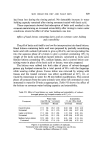
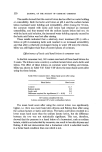
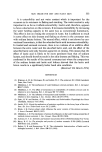
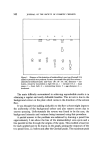
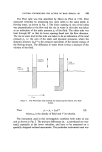
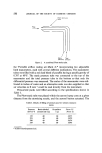
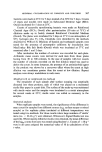
FACTORS CONTROLLING THE ACTION OF HAIR SPRAYS--Ill 549 The Pitot tube was first described by Henri de Pitot in 1732. Pitot measured velocities by immersing two open tubes to the same depth in flowing water, as shown in Fig. 1. The lower opening in one of the tubes was perpendicular to the flow and the rise in water in this tube was taken as an indication of the static pressure p• of the fluid. The other tube was bent through 90 ø so that its lower opening faced into the flow direction. The rise in water level in this tube was taken to be an indication of the total pressure Pt, i.e. the sum of the static and dynamic pressures, where the dynamic pressure «p0 V2 is the pressure equivalent of the kinetic energy of the flowing stream. The difference in water levels is thus a measure of the velocity of the fluid. Static p res su r•.•,•.•.• pressure I Total press••,• Flow Figure l. The Pitot-static tube method for measuring the velocity of a fluid stream. Thus Pt = P, + -}P0 V• (2) where P0 is the density of fluid and V its velocity. The instrument used in this investigation combines both tubes in one unit as shown in Fig. 2. The pressure differences (Pt- P•) produced are very small, especially at the lower velocities, and have to be measured on a specially designed inclined manometer. The particular instrument used was
Purchased for the exclusive use of nofirst nolast (unknown)
From: SCC Media Library & Resource Center (library.scconline.org)