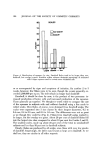
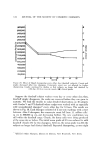
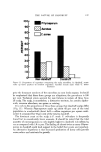
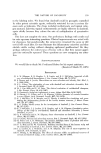
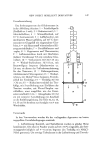
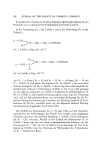
122 JOURNAL OF THE SOCIETY OF COSMETIC CHEMISTS 2C 10 SCALES [•1 Noa-dandruff E•'•iDandruff •.,-. O• Long#t diameter • mm Figure 4. Distribution of squames by size. Dandruff flakes tend to be larger than non- dandruff, but overlap is great. Numbers within columns designate percentage of nucleated cells. Larger squames tend to contain more nucleated cells or so accompanied by signs and symptoms of irritation. By another 2 to 3 weeks, however, few flakes were to be seen, though the counts generally ex- ceeded 2,000,000 per sq cm. The individuals no longer had dandruff! Dandruff, it should be clear by now, is the product of two processes: in- creased production of horny cells and increased production of the squames. These generally go together. We thought it worth while to compare the size of the squames in subjects with and without dandruff using a fine comb to collect scales. More flakes, of course, were obtained from dandruff scalps. The scales were separated into 3 size classes by their longest diameters, 0.2 to 0.4 mm, 0.4 to 0.8 mm, and 0.8 to 1.6 mm. The differences were not as great as we though they could be (Fig. 4). Flakes from dandruff scalps tended to be larger, but the overlap was great. About 20 per cent of dandruff flakes fell into the largest size class compared to about 10 per cent for Grades I and II. The smallest scales, made up about 25 per cent of the total in nondandruff subjects and less than 50 per cent in dandruff subjects. Clearly, flakes are produced by all scalps, even those with very low grades of dandruff. Surprisingly, the latter may be just as large as in dandruff. As we shall see, they are similar in all other respects.

THE NATURE OF DANDRUFF 123 VII. Tnr• Covns• or DAN•)nUFr We had the opportunity to follow institutionalized dandruff subjects in- cluding young adults and the elderly for a year or more. The scalps were as- sessed both by clinical grades and by corneocyte counts. Apart from the already mentioned seasonal variations, we have come to the conclusion that dandruff is a rather stable process. Counts and grades vary little over many months. The extraordinary week to week oscillations in the severity of dandruff reported by Van Abbe and Dean are outside our ken (4). We regard scaling to be about as steady a process as sebum excre- tion or hair growth rates, although more easily modified by external factors. As we see it, once an individual develops dandruff he will have to live with it till old age slows down epidermal proliferative activity. Dandruff does not come and go, folklore notwithstanding. The saying, "getting ones dander up" applies not to dandruff, but to seborrheic dermatitis, an unrelated con- dition. It should be pointed out that the corneocyte counts are likewise quite sta- ble. It would appear that the rate of production of horny cells and scales is a rather fixed characteristic as typical of an individual as his complexion or body odor. VIII. Is DANDRUFF A DtSEASE? A disease exists when there are structural or behavioral changes, which are qualitatively different from the nornaal, a distinction that is not always easy to make. The finding of tissue pathology, gross or microscopic is decisive. As we now conceive the process, dandruff is not a disease in the visual sense. No feature can be found which is absent in "normals." The differences are purely quantitative. People with dandruff make more horny cells and more scales. Desquamation is a physiologic process individuals are distribut- ed along a continuum depending on rates of shedding. There can be no sharp dividing line between dandruff and nondandruff subjects. As with all physiologic processes, the population can be fitted into the normal bell shaped curve. Using corneocyte counts, we have shown that the rates of horny cell production are log normally distributed, that is, a bell shaped curve is ob- tained when frequency is plotted against the log of the corneocyte count. Accordingly, the averages are expressed as geometric means rather than arithmetically. For statistical analysis, the values must first be transformed into logs. People with dandruff are located to one side of the bell shaped curve. The proper terminology is not dandruff versus "normal," but dandruff ver- sus nondandruff. Where the line is drawn is, of course, quite arbitrary. Since dandruff is only an intensified state of desquamation and scaling, it
Purchased for the exclusive use of nofirst nolast (unknown)
From: SCC Media Library & Resource Center (library.scconline.org)