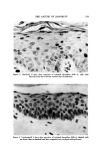
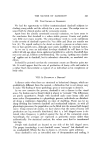
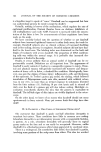
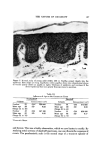
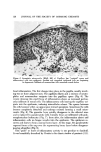
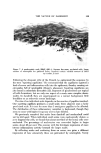
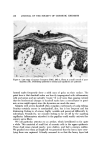
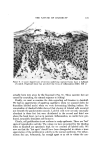
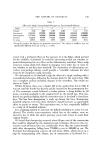
128 JOURNAL OF THE SOCIETY OF COSMETIC CHEMISTS Figure 6. Spongiotic microvesicle (H&E, 260 x). Capillary has "squirted" serum and inflammatory cells into epidermis. Swollen and separated epidermal cells are beginning to degenerate. Infiltrate of mononuclear cells surrounds venule below focal inflammation. The first change takes place in the papilla, usually involv- ing two or three adjacent ones. The capillary dilates and a mixture of neutro- philes and mononuclear emigrate into the papillary space (Fig. 6). The venule draining this small focus of inflammation shows an increased perivas- cular infiltrate of round cells. The inflammatory cells leaving the capillary mi- grate into the epidermis, inducing intercellular edema. The spaces between the cells become wider, an appearance termed spongiosis. Sometimes the cells become completely detached and undergo necrosis forming a small micro- vesicle (Fig. 6). The granular layer quickly disappears in the affected zone and is replaced by parakeratotic cells. Initially these are infiltrated with poly- morphonuclear leukocytes (Fig. 7). Soon after, the inflammation abates and inflammatory cells no longer wander into the epidermis. The epidermis re- covers and starts to form a normal horny layer. At this stage, the parakeratotic segment forms a thin cap over the regenerating horny layer before disappear- pearing altogether (Fig. 8). This "pulse" or burst of inflammatory activity is nor peculiar to dandruff. It was beautifully described by Civatte in his classic studies of psoriasis (11).

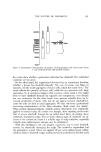
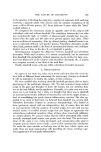
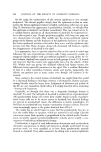
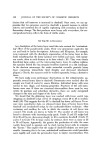
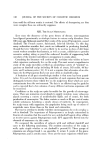
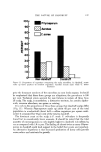
TIlE NATURE OF DANDRUFF 129 '•.•,.•.. •.!:•....- ..... .:.......: •'"'.:•'•..•-.:•::½" .............. :•:::.•... •..'%:•" •--id •- • -• •* ...• •.•:::•:::•:.:.• ......... .•?•-•:.'•.:.'.. •.::• ? ' '•: .•:L '.• .... ..:: ... -:,- .... •:-:- . -'• -....•-...: ............ •....:.•...... ........ ...• "•..•.,:•?('•-':•'::"*•:" --•:' Z•:-: •' •.• • ...... 1•:::: •:• ,'3. •:: •...d:" •.'•:,::• •:•:• :•': •.:.:., .•½?• ...... 2•'-.-:.,.-: ' "• •' . .-:-..- .... ..... ' : *'5-:•*e/:...½ •'":•'?' ....... ½. ( •::":." '%::• •": .' "-':•..:-• ..... :-' .... ... '5i•.""•"• .::•.""' --' 5. 24 '"=" ' :• :•, '"•" . - ' ...½ • ....%. •.:.- .....:.'.•.., .............. .... ..... .:. ................... '•. ........ •. %..• ........ .. , ..... • - '.•:•.," "•.:..::.:".%..•. •'• '.' •"" 7...:.. -, .:.:. ß .....'•. - -" :" •:':'"•%""' :'•:'..•'•::'•': 't'.':: '" '?'""":•'% 2:',?•'"?,'½•:--•""• ' ,: . .. -•' .' ..'.•. ............ ... '., ß .: .4 .. ' ..•..: • ß • :• -'.. •7• .... - ..... ß .............. .. . ,'•:...½•..:.....:::.:........ .:..•-:•........•:.: :•..,.•:: .: ...... ..' . , ..'...,..: .... :.'., % ..... .½ . •.- . •. . , • • .. .. •* •--.•.½,½• , ½.• .....•:.%..,.:%..._.,:.... ½•:: ß ::..• .•... .... ,•:.½... . ::....-'•-•' - •½•: :.. : .. , . . : - .•.• . -•. :' --...'•:•..::..:?"•:%" ' :•...'?:"•'.,•' .:•:4:,. '½ •::.'• '...'.:.:,•:,. •'.:..- d .,: . ß . - • •: •t, -- -• ': .... • , - •.. • • ..... ... -.,•....• ...... •,... • --:,.,. •--- ,...% .:.. , . % -- ,...- .¾-', •. •., -., •... ½.:. :... •......: . ,. - .. .. :.•. .. • :• , :- : . •. •- % • .... :::'?'?".. '..•$ •- .e" '- -7- ', ..?" :': % * .• '" -.• - '• .... •* .•7'• ':" .:&- -.,.S*c :'x: .' " --- . .. '-•, .' .'* '.,. *..., ..,• :...'$ •:.. . .•..'-- .:.S. *% .. Z.•-' ..-. .•. .. **- ,-...•½,'--•- -•::• '•'..,• 4:f- Figure 7. A parakeratotic scale (H&E, 620 x). Squaine has rnany nucleated cells. Large mm•ber of neutrophils has gathered below. Squames contain variable amount of dried up exudate, a crust Following the eloquent style of the French, he epitomized the sequence by the term "squirting capillaries." He envisioned that the capillaries squirted a load of serum and inflammatory cells into the epidermis, thereby creating mi- crovesicles full of neutrophils (Munro's abscesses). Squirting capallaries are also found in seborrheic dermatitis (12). Segments of parakeratosis are typical of both dermatoses, but are only one aspect of a much more complex abnor- mality. In danch'uff, they are superimposed on a normal background, little brushfires on an otherwise serene landscape. The size of an individual scale depends on the number of papillae involved. One squirting capillary produces a small scale, three adjacent ones a fairly good sized scale. It is rare for more than 3 contiguous papillae to be affected. The distribution of these inflammatory microloci is haphazard, though they seem to occur with higher h'equency next to hair follicles. We previously remarked that scales from dandruff and nondandruff could not be told apart. When individual sinall scales were lnechanically shaken so as to disperse the cells, we found that about one-third of the horny cells were nucleated. The percentage of nucleocytes was somewhat higher in larger scales, about 40 per cent. This concurs with the histologic impression of more intense inflammatory activity beneath the larger scales. By collecting scales and sectioning them en masse, one gains a different impression of how extensively these are permeated by neutrophils. Newly
Purchased for the exclusive use of nofirst nolast (unknown)
From: SCC Media Library & Resource Center (library.scconline.org)