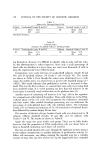
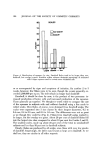
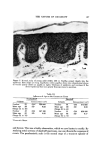
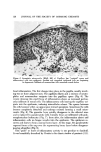
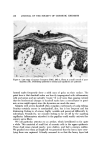
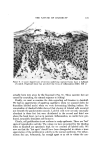
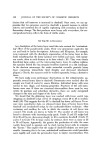
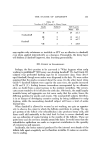
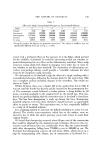
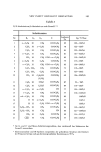
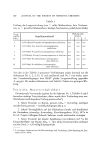
132 JOURNAL OF THE SOCIETY OF COSMETIC CHEMISTS clusion that cell turnover is increased in dandruff. Once more, we can ap- predate that two processes coexist in dandruff a general increase in mitotic activity and scattered foci of rapidly replicating cells secondary to focal in- flammatory change. The first produces more horny cells everywhere, the sec- ond produces horny cells in the form of visible scales. XI. THE SC IN DANDRUFF Any description of the horny layer must take into account the "contaminat- ing" effect of the parakeratotic scales. Their very prominence captivates the eye and leads to faulty descriptions. Ackerman and Klingman, for example, were impressed with the disorderly organization of the horny layer in dan- druff, remarking that the horny laminae were folded and wavy, with numer- ous cracks, often in such disarray as to form whorls (10). They were clearly describing large scales, not the intervening horny layer. In surface replicas, the squames looked like big irregular boulders scattered on a flat landscape. In the electron microscope, the scales somewhat resemble psoriatic horny layer (numerous intracellular lipid droplets and decreased attachment plaques ). Clearly, the squames must be studied separately, being a distinctive tissue. We have made some preliminary observations on the orthokeratotic, ap- parently normal horny layer in dandruff. Corneocytes were studied after the sample was freed of scales by coarse filtration. Individual horny cells were normal in size, shape, and staining properties. Fractures of the cell mem- branes were rare. If there are structural abnormalities these must be very subtle. In psoriasis and seborrheic dermatitis, there are easily recognized changes in the sizes and shapes of the horny cells. We found that the glistening layer was reached with fewer scotch tape strippings on dandruff scalps (10 to 15 strippings versus 26 to 48 in nondan- druff) (10). This suggests that the SC in dandrnff has fewer cell layers. To se- cure more quantitative data, we obtained intact discs of horny layers from dandruff and nondandruff scalps by the cantharidin-blister technique. After sectioning and swelling the cells in alkali, the number of cell layers was counted. The results are shown in Table IV. The number of cell layers was found to decrease with increasing scalp grade. Grade II and III scalps had 16 to 20 cell layers, decreasing sharply to 10 in moderate dandruff (Grade V) and to 7 in Grade VII. In large scales, by contrast, there were as many as 25 to 50 cell layers. Apparently, the greater the production of cells, the more readily these tend to separate and be shed, leaving fewer cells to comprise the "barrier." This implies that the scalps of dandruff subiects are more per- roeable. Assuming this to be true, antidandrttff medicaments would penetrate more rapidly and reach the germinative layer in higher concentrations. This

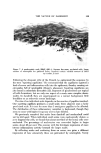
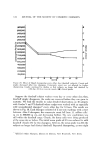
THE NATURE OF DANDRUFF Table IV Number of Cell Layers in Horny Layer 133 Grade Subjects Cell Layers Mean SD Nondandruff Dandruff II 5 20 _2.1 III 5 16 _1.1 V 8 10 ___1.7 VII 3 7 ___0.8 may explain why substances as insoluble as ZPT are so effective in dandruff, even when applied intermittently as a shampoo. Presumably, the horny layer will thicken as dandruff improves, thus lessening permeability. XII. EFFECT OF SHAMPOOING Perhaps, the first question to be answered is "What happens when scalp washing is prohibited?" Will every one develop dandruff? We had Grade III subjects wear perforated bathing caps for 21 consecutive days. None devel- oped dandruff, though more scales were dispersed in the hair. We were rather surprised that the grades remained about the same. On the other hand, when Grade V dandruff subiects wore caps for the same time, the grades increased to IX and X (1). Scaling became tremendous accompanied by an offensive odor, no doubt from a great increase in the resident microflora. The corneo- cyte counts tended to level off after the sixth day. Obviously, the small largely invisible horny cell aggregates are lost more easily that the scales, hence the differing patterns for grades and counts. The nondandruff subject, therefore, is in no danger of developing excessive scaling by being indifferent to scalp hygiene, while the nonwashing dandruff subiect will leave a trail of scales beyond him. When dandruff is allowed to worsen by not washing, one gets an opportu- nity to observe the extent to which the follicles contribute to scaling. The up- per portion of the follicle (the infundibulum) also produces horny cells, and these could add materially to the total load. In fact, in severe dandruff, one can see collarettes of scales forming in the mouths of the follic]es. These are quite loose and do not form sheaths around the hairs. It would seem that the infundibu]ar epithe]ium can make an important contribution to the quantity of corneocytes and squames. Incident]y, the horny material produced by the internal root sheath of the follicle falls apart completely and is therefore invisible. It makes no contribu- tion to scaling.
Purchased for the exclusive use of nofirst nolast (unknown)
From: SCC Media Library & Resource Center (library.scconline.org)