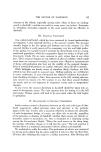
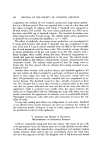
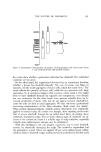
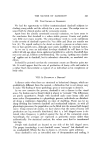
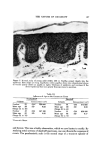
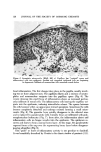
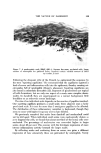
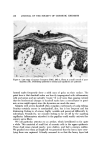
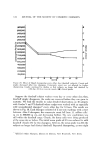
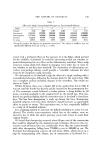
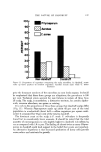
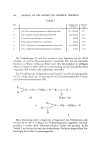
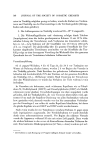
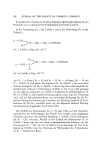
134 JOUltNAL OF THE SOCIETY OF COSMETIC CHEMISTS •oo, ooo •,4oo,ooc b•oo,ooc •ooooc •. 900,O(X) • 8oo,ooo • 5oo,ooo $00,000 200,00(1 I00,000 i0 12. 14 16 DAYS Figure 10. Effect of bland shampooing every other day (dandruff subjects). Counts and grades decreased after two shampoos. Corneoeyte count was not affected by further shampooing. Grades continued to decline so that subjects no longer had dandruff by •Oth day: (0) L.•xv neocyte counts (0) clinical grades Suppose the dandruff subject washes every day or every other day then, dandruff simply disappears the scales are removed before they can grow to maturity. We took the trouble to make detailed observations on 10 subjects with Grades V and VI dandruff whose scalps were washed with an especially mild nonmedicated shampoo • every other day for 8 times. The results are shown in Fig. 10. Each shampoo consisted of g one-rain washings with a rinse between. After g shampoos, the eorneoeyte count fell from 1.1 million cells/ sq em to 800,000/sq em-not decreasing further. The new equilibrium was still within the dandruff range. Clearly, the horny cells were being produced at the same rate as before. The initial mean grade of 5.5 was reduced to mild dandruff (Grade 3.8) by two shampoos. After six, the mean grade was III the subjects no longer had clinical dandruff. Bepeated shampooing, as one might *Johnson's Baby Shampoo, Johnson & Johnson, New Brunsxviel•, Nexv Jersey.

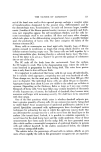
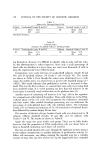
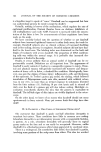
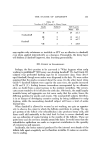
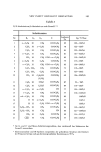
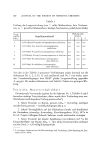
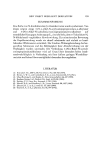
THE NATURE OF DANDRUFF Table V Effect of a Single Nonmedicated Shampoo on Ten Dandruff Subjects 135 Days 0 1 2 3 4 8 Grades a 5.29 2.00 2.57 4.00 5.14 5.57 Corneocyte 1024000 279600 532400 762600 1025000 1355000 Pityrosporum 1473000 343400 542400 791600 1486000 2109000 Aerobes 413200 61750 179200 388600 5081000 799700 C. acnes 40810 28040 5958 10200 18440 8634 "Except for grades, the figures are geometric means/era? The values in boldface type are significantly different from day zero (p = • 0.05). expect, had a profound effect on the squames. It is the flakes which account for the visibility of dandruff. It would be interesting to find out whether re- peated shampooing has any effect on the inflammatory microfoci. Many scalp conscious young adults feel obliged to shampoo every other day or more of- ten, whether or not they have dandruff. The elimination of inflammatory mi- crofoci, and perhaps itching, could provide a "scientific" rationale for what seems to be compulsive scalp cleansing. We determined on 10 dandruff scalps the effect of a single washing with a nonmedicated shampoo, following the changes daily for the next 8 days. This was a complete analysis including changes in the microflora. The results are shown in Table V. Within 24 hours, there was a drastic fall in the grades from 5.3 to 2.00. It was not until the fourth day that the grades returned to the pretreatment lev- el. The corneocyte counts followed a similar pattern, a sharp decline by 24 hours, returning gradually to the original level by the fourth day. This con- firmed our previous finding that the restoration time in dandruff is about four days. The loss from shampooing is made up during this time. Shampooing dandruff subjects every four days, therefore, should not have an appreciable effect on grades or counts. This expectation was, in fact, empirically fulfilled in a study of 15 dandruff subjects. It is of passing interest to note that the follicle-inhabiting C. acnes was not affected. The aerobic micro-organisms, which live on the surface, were re- stored by day 2 while the slower growing yeasts took 4 days to reach their original density. We found that shampooing removed about 40 per cent of the corneocytes that could be obtained by the detergent-scrub technique. However, the cor- neocyte count 24 hours later was considerably lower than the count immedi- ately after shampooing, falling from 770,000/sq cm to 288,000/sq cm. We theorized that shampooing removes oil and horny debris, which serves as a trap for desquamating cells. Hence, loss of corneocytes is facilitated for a
Purchased for the exclusive use of nofirst nolast (unknown)
From: SCC Media Library & Resource Center (library.scconline.org)