136 JOURNAL OF THE SOCIETY OF COSMETIC CHEMISTS time until the oil-horn matrix is restored. The effects of shampooing are thus more complex than one ordinarily supposes. XIII. T• Sc•v MICROFLORA Ever since the discovery of the germ theory of disease, microorganisms have figured prominantly as etiologie factors in various scalp disorders. Over 100 years ago, Malassez asserted that yeasts of the genus Pitgrosporum, caused dandruff. The French master, Sabouraud, believed likewise. To this day, many authorities consider that yeasts are influential in producing dandruff, though the term "infection" is not so likely to be used as in days of old. Some recent workers consider that bacteria, as well as yeasts, collaborate to provoke excessive sealing, citing as proof the enhanced benefits of suppressing both members of the resident mierottora in comparison to yeasts alone. Consulting the literature will confound the novitiate who wishes to know what organisms eustomarily live on the scalp. The most recent comprehensive study of the scalp microflora yielded an astonishing variety of "resident" or- ganisms on dandruff scalps including 30 kinds of yeasts, 143 molds, 44 bac- teria, and 8 actinomycetes (13). It is not a surprise that advocates of an etio- logic role for Pityrosporura find yeast moro often in dandruff scalps. A limitation of all past microbiologic studies is that none has been quanti- tative. It is only be determinin• the quantities of each organism that one can distinguish between those which live on the scalp from those which are mere contaminants from the environment. The hair is an efficient trap for particles and is expected that a few colonies of many different air-borne organisms will be recovered. Conditions on the scalp are quite favorable for the growth of micro-orga- nisms. There are numerous sweat glands to supply moisture, many sebaceous glands secreting a variety of metabolizable lipids, and of course, the brisk production of corneocytes. The latter contain as much as 20 per cent of water soluble substances furnishing a steady stream of nutrients. In consequence, the scalp teems with organisms, the population being made up of orders of magnitude more dense than on the trunk and extremities. The time is overdue to decide whether microorganisms do or do not play a role in dandruff. The importance of Pityrosporum is so deeply entrenched in theories of causation that the search for new antidandruff agents often utilizes an in vitro screen against Pityrosporum ovale. ZPT apparently flowed into the channels of commerce via this route. We compared the microflora of subjects with and without dandruff and came to the following conclusions. The resident microclora of the scalp is really quite simple whether or not dandruff is present(9). Three groups of organisms are always found 1. an anaerobe, C. acnes 2. yeasts of the genus Pityrosporum and 3. aerobic cocci. These are the same organisms which corn-

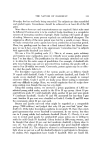
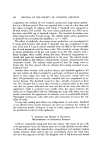
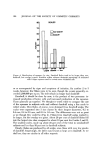
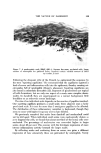
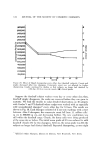
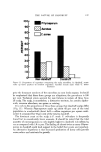
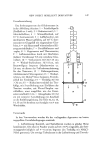
THE NATURE OF DANDRUFF 137 IOO 90- 80- 70- Pityrosporum Aerobes C.acne$ 4O 30 2O I0, 0 Dandrut Figure ii. Proportions of organisms comprising the scalp microflora. In dandruff, yeasts make up three quarters of resident organisms. Aerobes remain same while C. aches decreases prise the dominant members of the microflora in most body regions. It should be emphasized that these three groups are ubiquitous the prevalence is 100 per cent. Technical errors account for rare failures to isolate all three from all scalp. The scalp, is nonetheless, a distinctive territory, for aerobic dipthe- roids, common elsewhere, are sparse or missing. It is only in the proportions of these three groups that dandruff scalps differ (Fig. 11). Whereas Pityrosporum made up about 45 per cent of the total population in nondandruff (about half a million organisms per square centi- meter) it accounted for 75 per cent of the total in dandruff. The dominant yeast on the scalp is P. ovale. P. orbiculare is frequently found but in considerably lower amounts. It should be noted that the total quantity of microorganisms is only slightly higher in dandruff, 1.g million/sq cm as compared with 1.O/sq cm. The finding of almost twice as many Pityros- porum in dandruff could lend support to the belief that yeasts are important. An alternative hypothesis is that increased production of horny cells provide more surface and nutrients for growth.
Purchased for the exclusive use of nofirst nolast (unknown)
From: SCC Media Library & Resource Center (library.scconline.org)