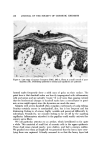
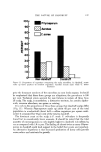
138 JOUBNAL OF THE SOCIETY OF COSMETIC CHEMISTS Curiously, the cocci were not increased in dandruff. Of surpassing interest was the substantial decrease of C. acnes in dandruff. In explaining this, it is useful to recall that C. acnes is a strict anaerobe. A slight increase in O2ten- sion will antagonize its growth. How could this occur in dandruff? Our sup- position is that the inflammatory microloci are just numerous enough to lessen the degree of anaerobiasis in the follicles where C. acn•es lives. We undertook to evaluate the rule of micro-organisms by eliminating them one at a time with appropriate antimicrobial agents and finally suppressing the entire microflora with a combination of agents (14). The effect on dan- druff was appraised by clinical grades and corneocyte counts. Suppression of C. acnes by oral tetracycline had no effect, as was expected. Inhibition of the areobes by topical neomycin had no influence whatever on grade or counts. Virtual elimination of P. ovale by topical amphotericin B for 4 weeks had no discernible effect on dandruff. This was sufficiently important to justify a longer study on the assumption that reduction in scaling might have a long lag time. This possibility was ruled out when it was found that 9 weeks of amphotericin B brought no changes in the grades or corneocyte counts. We followed the Pityrosporum trail even further hoping to put the matter to rest, once and for all. This time, dandruff and P. ovale were both sup- pressed by twice weekly shampooings for 3 weeks with 2.5 per cent SeS sham- poo. Then, half the subjects used only a bland shampoo twice weekly, while the other half received topical amphotericin to prevent the regrowth of P. ovale. In both groups, grades and counts returned to the pretreatment level at the same rate, in 4 to 6 weeks. Finally, all three medicaments were given simultaneously resulting in con- comitant suppression of aerobes, yeasts, and anaerobes. Dandruff remained unaffected. These data are strongly apothetical to the belief that micro-organisms play a role in dandruff. In our view, the reign of P. ovale is at an end. Increase of P. ovale in dandruff is a consequence of increased scaling not its cause. On the other hand, there is no room for ambiguity concerning the inflam- matory microloci. These do represent a pathologic process. The tissue in these areas is structurally and functionally abnormal. Disease exists at these sites. We have no insights as to their causation. XIV. MoI)•: or ACTION OF ANTn:)ANDRUFF AGENTS On numerous occasions, we have measured the effectiveness of ZPT and SeS shampoos on dandruff. These invariably exert a suppressive effect, the latter being more potent. Their mode of action seems to be cytostatic. They decrease epidermal proliferation by inhibiting the multiplication of germina- five cells. We found that SeS decreased the corneocyte count to about the same extent in nondandruff subjects (15). There was a corresponding decline

THE NATURE OF DANDRUFF 139 in the labeling index. We found that dandruff could be promptly controlled by other potent eytostatic agents, ordinarily restricted for use in serious dis- eases such as leukemia. The drugs included methotrexate and topical nitro- gen mustard. Likewise, topical eortieosteroids are highly effective in dandruff, again chiefly because they rednee the rate of multiplication of germinative cells. This does not complete the story. Our preliminary findings with crude coal tar raise up some interesting questions. Clinical improvements was noted with tar shampoos, but paradoxically, the eorneoeytes remained the same or did not fall till much later. Do tars eliminate the inflammatory microloci and thus abolish visible sealing without changing epidermal proliferation? Do they perhaps influence the eohesiveness of horny cells so that they cannot aggre- gate into noticeable squames? These questions are now occupying our atten- tion. ACKNOWLEDGMENTS We would like to thank Mr. Ferdinand Huber for his expert assistance. (Received March 9,7, 1975) I:•EFERENCES (lO) (11) (12) (13) (14) (15) (1) A.M. Kligman, R. R. Marpies, L. R. Lantis, and K. J. McGinley, Appraisal of effi- cacy of antidandruff formulations, ]. Soc. Cosmet. Chem., 25, 73 (1974). (2) S. Bourne and A. Jacobs, Observations on ache seborrhea and obesity, Brit. Med. ]., 1, 1268 (1956). (3) E. L. Cohen, The relationship of acne with dandruff and seborrheic dermatitis, Brit. ]. Dermatol. Sgph., 57, 45 (1945). (4) M. J. Van Abbe and P.M. Dean, The clinical evaluation of antidandruff shampoos, J. Soc. Cosmet. Chem. 18, 439 (1967). (5) N. Orentreich, Scalp hair replacement in man, Advan. Biol. Skin, 9, 99 (1967). (6) G. Plewig, J. E. Fulton, and A.M. Kligman, Cellular dynamics of comedo formation in ache vulgaris, Arch. Dermatol. Forsch., 237, 703 (1970). (7) K. J. McGinley, R. R. Marples, and G. Plewig, A method for visualizing and quan- titating the desquamating portion of the human stratum comeum, J. Invest. Derm- atol., 53, 107 (1969). (8) J. A. Troller, Model system for the investigation of dandruff, J. Soc. Cosmet. Chem., 22, 187 (1971). (9) K. J. MeGinley, J. J. Leyden, R. R. Marples, and A. M. Kligman, Quantitative micro- biology of the scalp in non-dandruff, dandruff and seborrheic dermatitis, J. Invest. Dermatol., in press. A. B. Aekerman and A.M. Kligman, Some observations on dandruff, J. Soc. Cosmet. Chem., 20, 81 (1969). A. Civatte, Psoriasis and seborrheie eezema, Brit. J. Dermatol. Syph., 36, 461 (1924). H. Pinkus and A. H. Mehregan, The primary histologic lesion of psoriasis and sebor- rheie dermatitis, ]. Invest. Dermatol., 46, 109 (1966). F. C. tloia and R. W. Vanderwyk, Resident microbial flora of the human scalp and its relationship to dandruff, J. Soc. Cosmet. Chem., 20, 113 (1969). J. J. Leyden, K. J. MeGinley, and A.M. Kligman, The role of micro-organisms in dandruff, Arch. Dermatol., in press. G. Plewig, A.M. Klingman, The effect of selenium sulfide on epidermal turnover of normal and dandruff scalps, J. Soc. Cosmet. Chem., 20, 767 (1969).
Purchased for the exclusive use of nofirst nolast (unknown)
From: SCC Media Library & Resource Center (library.scconline.org)