116 JOURNAL OF THE SOCIETY OF COSMETIC CHEMISTS evaporation, the residual oil was weighed, giving total scalp sebum produc- tion for a 24-hour period. This was repeated after a rest of a few days and the values averaged. 18 subiects with Grade V dandruff were compared to 16 with Grades of II and III. The mean sebum production was 378.3 mg in the latter and 419.4 mg in dandrnff subiects. The standard deviations were rather large but similar in both groups. The slightly higher sebum production in dandruff was not statistically significant ( p -- 0.05). The effect of artificially decreasing sebum production was investigated in 6 young adult females with Grade V dandruff, who also complained of oili- ness. Each took 0.1 mg of ethinyl estradiol from the fifth to the twenty-fifth day of each menstrual cycle for three cycles. This caused an average decrease in sebum production of 44 per cent (range 31 to 52). The subjects used a bland shampoo twice weekly during this time. Menstrual irregularities oc- curred, but were not considered pertinent to the issue. The clinical grades remained stable as did objective measurements of horny cell production (the corneocyte count). The subjects easily perceived that the scalps were no longer oily, but they agreed with our estimate that scaling remained at pre- treatment level. Another three females with marked oiliness and dandruff applied a 0.5 per cent solution of ethinyl estradiol in equal parts of ethanol and propylene glycol to their scalps once daily for 30 days. Corneocyte counts were not done. Oil production was so severely curtailed that two complained of ex- cessive dryness. The dandruff seemed to have actually worsened in these two. We interpret this to mean that oil tends t•o conceal scales in the same way that any grease obliterates the look and feel of dry scaly skin after its application. Light is scattered more readily when the spaces between the scales are no longer filled with fat. Defatting the scalp with either one may greatly accentuate the appearance of scaliness, even in nondandruff subjects. Thoroughly wetting the scalp with water also transiently decreases the visi- bility of scales. In any case, sealing and oiliness are independent of each other. Dandruff is not affected when female hormones are given to decrease the volume of the sebaceous glands. Estrogens, it may be noted, apparently do not affect the proliferative activity of the epidermis. V. ASSESSING THE DEGREE OF DANDRUFF: MEASUREMENT OF EPmERMAL KINETICS Cells are continually being shed from the surface. The source of new cells is the germinative layer, the bottom most row of cells directly over the derm- is. These cells comprise the reproductive compartment and undergo random mitotic divisions. Some cells in the row immediately above the basal layer also have the capacity to divide. The daughter cells of cell division are forced

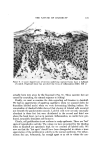
THE NATURE OF DANDRUFF 117 out of the basal zone and in their upward passage undergo a complex series of transformations designated by the general term, 'differentiation' and by the dermatologic term, 'keratinization.' As each cell becomes larger, tonofila- ments (bundles of the fibrous protein keratin) increase in quantity and thick- ness, new organelles appear, the cell membranes thicken, and the eelIs be- come increasingly stuck to one another. All these and many other changes, which take place in the differentiating compartment, have a specific biologic goal, the production of horny cells. The latter comprise the fabric of the stratum corneum (SC). Horny cells or corneocytes are dead rigid cells, literally bags of fibrous protein encased in membranes so tough that strong alkalis dissolve out the cellular contents leaving empty sacs. The horny cells are held together by a strong intercellular glue, forming thereby a coherent horny layer The func- tion of the latter is to act as a "barrier" to prevent the passage of substances into or out of the skin. The SC seals off the body from the environment. Near the surface, the SC begins to crack. This is the desquamating zone, where the cells be- come loosened in preparation for their being shed. This outer loose porous zone is only three to four eel] layers thick. It is important to understand that horny cells do not come off individually, but in variably sized aggregates, comprising tens and even hundreds of cells. These clumps are, for the most part, invisible, being less than 200/xm (0.2 mm) in diameter. The individual horny cells are about 40 /xm in diameter. Aggregates larger than about 0.2 mm are visible to the naked eye as flakes or squames. Depending on the thickness, flakes as large as 2 mm may contain thousands of horny cells. Very large flakes may contain hundreds of thousands of cells. Squames are, of course, the hallmark of dandruff they become more numerous and larger with increasing severity. We shall have to be concerned with their origin. One of the first questions which arises is whether dandruff subjects pro- duce a greater quantity of horny cells. Or are corneocytes merely being shed in visible flakes? Some measurement of epidermal proliferative activity is re- quired. Specialists concerned with epidermopoesis have developed various techniques for estimating the rate at which the epidermis renews itself. One can determine the average time for a cell to move from the basal layer to the surface (the transit time). Indeed, it is possible to calculate separately re- newal times for the dead horny layer and the viable epidermis. None of these measurements have been made for the scalp. Still, we have generated some data which enables a meaningful comparison of epidermal kinetics in persons with and without dandruff. In the studies summarized below, the subjects were always young adult males. The mitotic index, the percentage of basal cells in mitosis, affords an esti- mate of how rapidly the celts in the germinative conapartment are reproduc-
Purchased for the exclusive use of nofirst nolast (unknown)
From: SCC Media Library & Resource Center (library.scconline.org)