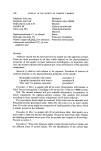
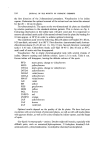
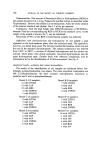
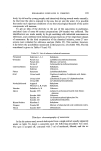
RISK-BEARING SUBSTANCES IN COSMETICS 167 method A or B must be used. For the identification of chromic or iron oxide the sample should be ashed on a platinum dish to remove additives and the carbon. The next step is to assess the colour components visually by observation of the original sample and of the striated centrifugal sediment. Assessment should be within the following defined colour groups: GREEN RED BLACK BLUE YELLOW-ORANGE PEARL VIOLET BROWN WHITE For example bluegreen should be assessed Blue and Green. The assessment of colour components of the sample is necessary to guide the analysis. Table H gives for each colour component the possible groups of colour compounds. Table II. Possible groups of colour-compounds for the assessed colour components GREEN Chromium-oxides Ultramarines Organic colours BLUE Ultramarine Iron-compounds Cobalt-compounds Organic colours VIOLET Ultramarines Manganese-compo unds Organic colours RED Iron-compounds Organic colours YELLOW-ORANGE Iron-compounds Organic colours BROWN Iron-compounds Manganese-compounds BLACK Carbon Iron-compounds PEARL Pearlescent compounds WHITE White compounds All the possible groups of compounds should now be investigated systematic- ally by characteristic reactions and methods that belong to each group of com- pounds. Characterization reactions and methods Ash. Ash a small sample on a platinum dish, heated by a microburner. Observe the colour changes during the heating and after cooling. Sulphuric acid 4M. Add a small amount of the isolated pigment to -•- ml of the acid. Observe before and after gentle heating. Gas evolution and colour changes

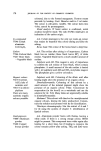
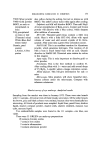
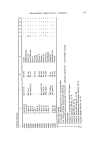
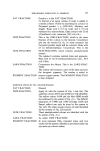
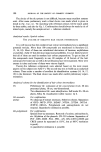
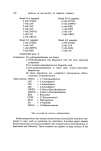
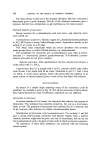
168 JOURNAL OF THE SOCIETY OF COSMETIC CHEMISTS might occur. H•S gas can be smelt and chemically confirmed by the browning of lead acetate/cotton plugs. Hydrochloric acid 6M. Heat a little of the ash residue (1) with « ml of the acid. Coloration might occur. NaOH 8M. Add a little of the isolated pigment to « ml of NaOH 8M. Gas evolution or coloration might occur. Aqua regia. (50•o Nitric acid •- HC1 6M, 3: 1 v/v.). A little of the isolated pigment is added to « ml of aqua regia. The pigment might dissolve and the liquid colour. Di•nethylformamide (DMF). Add a little of the isolated pigment to 1 ml of DMF. Coloration of the solvent might occur. Methanol. Add a little of the isolated pigment to 1 ml of methanol. Colora- tion of the solvent might occur. Sodium peroxide melt. Melt a small amount of the ash residue (1) with several granules of sodium peroxide in a vitreosol or quartz crucible. Observe colour after cooling. If characteristic reactions should be obtained with this melt, all of the excess sodium peroxide should first be decomposed by excessive heating. Borax bead. Melt borax powder on a platinum wire loop with a little of the ash residue (1). Observe the colour of the hot bead and after cooling. Dissolution. Heat a small amount of the ash residue (1) with a mixture of ca 0.25 g KHSO4 and ca 0.25 conc. sulphuric acid, in a small kjeldahl flask over a small flame of a microburner. Cool and dilute with water. Thin-layer chromatography. Details of tlc identification will be given under chapter 3: lipstick colours. Metal analysis. This will not be discussed in this paper. Microscope. Suspend the isolated pigment in glycerol. Observe plate structures and colour interference under the microscope. Compare with reference samples. Observations Chromium-oxides 77288 Cr•Oa 77289 2CrOa.3H•.O Ash. Both pigments turn grey during the ashing, which becomes dull-green after cooling. Sulphuric acid 4M. Chromic oxides are insoluble and remain unchanged by this reagent. NaOH 8M. Chromic oxides are insoluble and colour persists in this reagent.
Purchased for the exclusive use of nofirst nolast (unknown)
From: SCC Media Library & Resource Center (library.scconline.org)