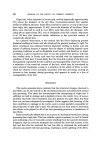
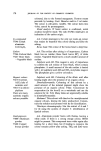
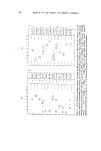
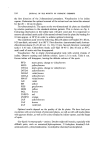
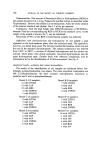
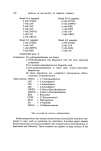
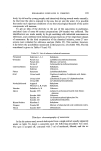
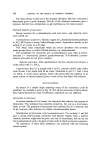
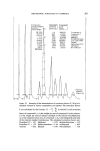
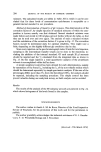
206 JOURNAL OF THE SOCIETY OF COSMETIC CHEMISTS Propellant 11 (Trichlorofluoromethane) has a boiling 75% point of 23.8øC. The histogram profile shows clearly that this compound is the most important propellant/solvent in hairspray aerosols. Average 50% % between 30 and 60% in 4 samples more than 80%! 25% 12 is an important propellant in hairspray aerosols.
Propellant 75% Found in 80% of the samples average 20-25%.
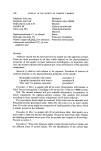
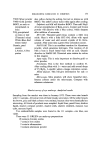
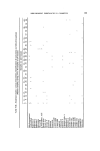
(Dichlor Dimeth. ylether: Two samples contain dimethylether -•50% which is only recently introduced as a prope!lant. Et OH --.- 75% --- 50% --- 25% I1 .•75% ,•l,11111111111•,1111111111 I,,,lll•,•11! •111 DCM + MChl I max. 25% Ethanol is an important solvent. Almost all samples contain ethanol at a level of 10%. Some samples contain 25%, but higher levels do not OCCUr. Methanol. Small amounts (less than 0.5%) are found in 45% of the samples, probably as a denaturant of ethanol or isopropanol. Dichloromethane + methylchloroform (DCM+MChl): These chlorinated solvents are used instead of ethanol to lower the price of the hairspray aerosol. The Dutch Cosmetic Bill states a maximum of 25%. Two samples contain more, namely 42.8% and 34.2%. A quarter of our samples do not contain chlorinated solvents. Hydrocarbons (Propane+nButane+iButane) are used • prop• in 25% of the samples. In one sample even more than 40%, but the average % is 20%. Inflammable compounos (Sum of hydrocarbons- dimethylether-aceton-methanol-ethanol-isopropanol). Only four samples exceed the 45% inflammable compound which is accepted by aerosol technologists as an upper limit for the fire safety of aerosols. Pro + iBu + nBu .• Inflammable compound 75% ( Branbare Staffen) , • Figure 14. Histograms of the results: total analysis of propellants and solvents of hairspray aerosols (60 samples). 75% 50% 25%

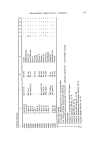
RISK-BEARING SUBSTANCES IN COSMETICS 207 REFERENCES Eye-make-up colours (1) Documentary eye preparations. Amer. Perrum. Cosmet. March (1971). (2) Cosmetica. Besluit Sept. (1969) (Staatsblad der Nederlanden). (3) EEC proposed list III/2255/71-D for cosmetics. (4) Mitt. 3 Farbs. Kommi. Deut. Forschungs Gemeinsch. October 21 (1967) and November 11 (1968). (5) Davenport, O. US Government regulations on color additives to be used in eye prepara- tions. Lipstick colours (6) Unterhalt, B. 13bet die Bestimmung von Lippenstiftfarben, Z. Lebensm. Unters. Forsch. 144 109 (1970). (7) Lehmann, G., Einschi•tz, H. and Collet, P. Beitrage zur Analytik der Farbstoffen III. Z. Lebensm. Unters. Forsch. 143 187 (1970). (8) Deshusse, J. and Desbaumes, P. Identification des colorants des rouges h 16vres par chrom. sur couche mince. Mitt. Geb. Lebensm. Hyg. 57 373 (1966). (9) Silk, R. S. Separation of synthetic organic colours in lipsticks. J. Ass. Off. Agr. Chem. 48 838 (1965). (10) Cotsis, T. P. and Garey, J. C. Proc. TGA 41 3 (1964). (11) Woidich, H. and Gnauer, H. Nachweis und Identifizierung kiinstlicher wasser16sichen Farbstoffe. Lebensm. Kosmet. Wien (1970). (12) Perdih, A. Analytik kosmetischer Farbstoffe. Z. An. Chemie 260 278 (1972). OxMation colours (13) Wall, Fl. Bleaches, hair colorings and dye removers. Sagarin's Cosmetics 479 (1957). (14) Urquizo, S. Identification de quelques amines aromatiques et compos6s phenoliques par chrom. s. couches minces. Ann. Fals. Exp. Chim. 27 (1969). (15) Zviak, C. and Sidi, E. La coloration des cheveux. Probl•mes Capillaires (1966) (Gauthier- Villars, Paris). (16) Vogel, J., Floriani, R. and Berner, Ch. Identification des amines contenues dans les teintures pour cheveux. Mitt. Geb. Lebensm. Hyg. 59 107 (1968). (17) Kotteman, C. M. Two-dimensional tlc procedure for the identification of dye intermediates in arylamine oxidation hair dyes. J. Ass. Offic. Agr. Chem. 49 954 (1966). (18) Tucker, H. H. The formulation of oxidation hair dyes. Amer. Perf urn. Cosmet. 59 (Oct. 1968) and also in Hair colouring with oxidation dye intermediates in J. Soc. Cosmet. Chem. 18 609 (1967). (19) Goldstein, S., Kopf, A. A. and Feinland, R. Analysis of oxidation dyes by thin layer and gas chromatography. Proc. Conf. Cosmet. Sci. April 19 (1968). (20) Willeboordse, F., Quick, Q. and Bishop, E. T. Direct GC analysis of isomeric diamino- toluenes. An. Chem. 40 1455 (1968). (21) Boufford, C. E. Determination of isomeric diaminotoluenes by direct glc. Z. Anal. Chemie (1968). Suntan-preparations (22) Strobel, A. and Inserra, J. J. The use of uv absorbers in cosmetic products. Amer. Perrum. Cosmet. 83 25 (Dec. 1968). (23) Kuebler, H. Sonnenschi•tzspray und Sonnenschtitzpreparate, Seifen 6le Fette, Wachse 94 182 (1968). (24) Kumler, W. D. Relative action of sunscreen compounds. J.A.Ph.A. 492 (1952).
Purchased for the exclusive use of nofirst nolast (unknown)
From: SCC Media Library & Resource Center (library.scconline.org)