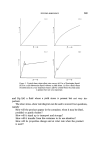
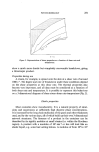
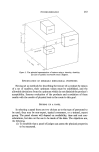
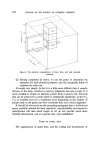
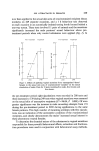
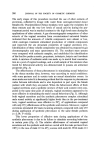
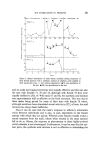
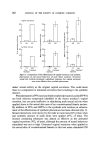
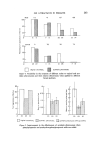
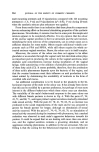
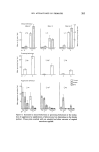
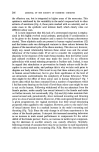
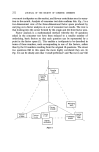
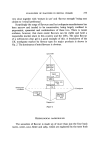
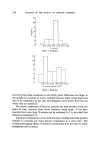
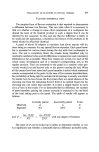
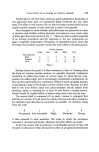
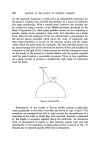
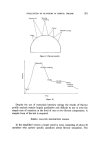
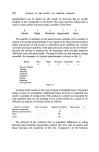
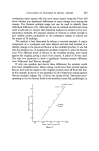
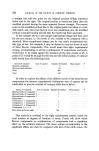
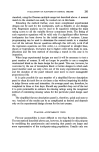
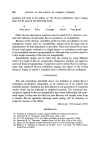
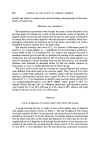
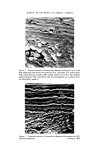
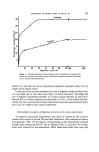
252 JOURNAL OF THE SOCIETY OF COSMETIC CHEMISTS describes a product which is moving from 'soft' to 'firm' to the touch. A modulus of 106 or over would indicate a hard substance not suitable for many cosmetic applications other than various types of pencils. These values provide an order-of-magnitude indication of the information to be gained from the measurement of a single physical property in practice the perceived texture of a product results from a combination of several different properties. THE PICTORIAL REPRESENTATION OF TEXTURE Rheological properties of general importance for cosmetics are viscosity, rigidity and yield behaviour, and their dependence on shear rate, age and temperature. Of less general importance but nevertheless very important to individual products are such properties as greasiness, tensile strength, stickiness (or the lack of it), brittleness and surface tension. It would be very convenient to be able to represent all these properties on one texture- gram. However, it would have so many dimensions as to be impossible to understand, even if it could be drawn. Using just three variables it is possible to represent a wide range of textures on one diagram. Fig. 2 shows how the properties during use of creams can be displayed on a i-:f-T diagram. Three other useful variables are viscosity, elastic modulus and the degree of quickly recoverable strain. The latter property eliminates thixotropic products from the display. Con- sider a material with a modulus of 5 x 10⁵ nm -s and a viscosity of 104 cp, something like the values to be expected for a slightly under-ripe banana. If it had a quickly recoverable strain of 50•o it could be compressed to half its original thickness, and regain its former shape as soon as the stress was removed. This product would be described as rubbery to the touch. If it could only recover from a strain of 2•o, breaking up if this strain were exceeded, it would be described as brittle. Similarly, a product with a low elastic modulus, say l0 s nm -s, medium viscosity, say l0 s cp, and a fairly high recoverable strain, say 50•o, would feel slimy to the touch. These three textures are plotted on the texturegram in Fig. 3. It must be remembered that when specifying viscosities and elastic moduli, the conditions of measurement must correspond to those in the application being considered. Various other textures can be represented on this diagram, for example hard, firm, soft and brittle solids, pourable, non-pourable and elastic liquids. Some of these are shown in Fig. 4.

PSY CHO-RHEOLOGY 2 5 3 10 5 'E 10 3 • i0 • x/'•sc o•½•J'cp ] Figure 3. The pictorial representation of texture using a viscosity, elasticity, per cent of quickly recoverable strain diagram. SPECIFICATION OF DESIRABLE RHEOLOGICAL PROPERTIES Having set up methods for describing the texture of a product by means of a set of numbers, their optimum values must be established, and the allowable deviations from the optimum which do not diminish the product's acceptibility. Sensory evaluation of the products and correlation of these results with the results of physical tests is the route to this goal. SETTING UP A PANEL In selecting a panel there are two choices as to the type of personnel to be used they may be non-expert, typical consumers, or a trained, expert group. The panel chosen will depend on availability, time and cost con- siderations, but also on the use to be made of the data. The objectives are, the following, (i) To establish that a panel of judges can assess the physical properties to be measured.
Purchased for the exclusive use of nofirst nolast (unknown)
From: SCC Media Library & Resource Center (library.scconline.org)