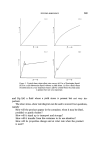
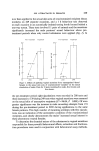
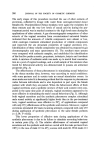
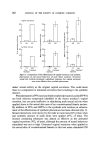
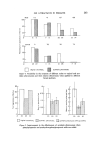
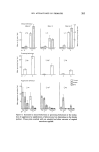
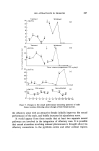
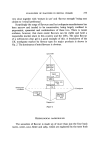
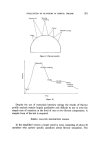
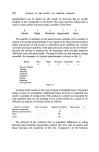
250 JOURNAL OF THE SOCIETY OF COSMETIC CHEMISTS The initial impression This is very important to the saleability of any product. A shear rate of 50-100 s -• corresponds to that which the product would suffer when tilted, gently shaken or prodded. At this shear rate a measured viscosity of less than 100 cp would be easily pourable as the viscosity increased the product would become gradually stiffer until at 1000 cp it would appear solid under these conditions. The importance of looking at the viscosity at the appro- priate shear rate is obvious from Fig. l(c). Some products appear solid at low shear rates but liquid at high ones. Storage and transport properties Since cosmetics will often be stored for several months or even years before use, it is important that they are stable. This simply means that the physical properties chosen as being of importance to acceptability must remain within some specified limits during the expected lifetime of the pro- duct. The acceptable limits are defined by sensory evaluation. It must be ascertained by physical testing whether a product can stand up to the shear- ing it will receive in transport so that a product arrives on the shelf in a suitable condition. This does not apply of course to thixotropic products since they regain all their original structure when allowed to rest after shearing. The impression on removing from the container The yield stress has an important influence on the. way in which a pro- duct will leave the container. Its position on the i-3• diagram defines at what stage of usage (at what shear rate) breakdown will occur, how much force is needed (what shear stress) to initiate breakdown, and how much of the total structure is destroyed when the yield stress is exceeded. A simple example illustrates its importance. When the end is removed from a tooth- paste tube the paste must not run out it must be held in place by its yield stress. The pressure needed to exceed the yield stress must be reasonably low, otherwise either the tube would burst or the sink would be full of toothpaste! When the yield stress has been exceeded the product must still retain most of its structure, so that it will remain intact on the brush and not drip off before it can be used. Given these requirements it is possible to predict the shape of a toothpaste flow curve without knowing any of the numerical values. Yield properties are varied by the dispersed phase concentration and the types and amounts of stabilizers used. Some gums and gelling agents give non-recoverable breakdown at 10w shear stresses, while clays can

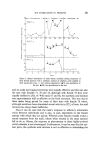
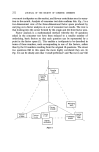
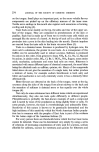
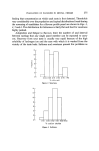
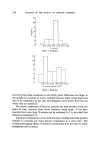
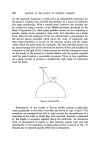
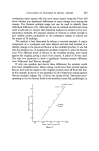
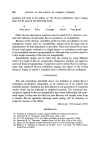
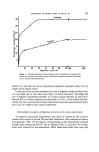
PSYCHO-RHEOLOGY 251 Figure 2. Representation of shear properties as a function of shear rate and temperature. show a much more drastic but completely recoverable breakdown, giving a thixotropic product. Properties during use A cream, for example, is spread onto the skin at a shear rate of around 1000 s -x. The degree and rate of breakdown under these conditions depend on the shear properties at this shear rate. The thermal properties also become very important, and all data must be considered as a function of both shear rate and temperature. It is possible to represent this behaviour on a 3-dimensional diagram of shear stress-shear rate-temperature (Fig. 2). Elastic properties Most cosmetics show viscoelasticity. It is a natural property of emul- sions and suspensions at sufficiently high disperse phase concentrations. It is increased by the long chain molecules of the gums and other thickeners used, and by the various clays, all of which build up their own 3-dimensional network structures. The firmness of a product in the container can be described by its rigidity modulus at small strains (i.e. within the Hookean region). A product with a modulus of 10 •' nm -•' or less will look like an elastic liquid, e.g. some hair setting lotions. A modulus of from 10 a to 108
Purchased for the exclusive use of nofirst nolast (unknown)
From: SCC Media Library & Resource Center (library.scconline.org)