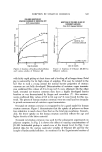
(d) Figure 7. SEM montages showing effects of Croda "Collasol" when applied to mildly dry skin: (a) before, (b) after water only, (c) after collasol plus water rinse, and (d) after collasol (no rinse). Note indications of smoothed skin texture, and that water alone does virtually nothing. Scale bars represent 100 t•m

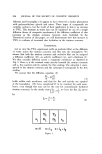
526 JOURNAL OF THE SOCIETY OF COSMETIC CHEMISTS Figure 8. SEM cross-sectional montages showing "profile" of hu- man skin evidence that this material is substantive to human skin. When Collasol is ap- plied and not rinsed off, there has been an even more obvious smoothing feet. Are these moisturizing effects? Clearly, xvater alone did virtually nothing to the stratum corneum that we can see. There are those who believe materials such as Collasol attract moisture, thereby "holding" moisture to the skin. In any case, one does apparently perceive a clinical (ffcct with Collasol (11) and the replicas tend to support that clinical fact. To summarize, these results indicate that any cosmetic treatment that re- duces the number or size of uplifting layers on the stratum corneum will resuk in a beneficial clinical effect and the quantitative measurement of efficacy of a product can be obtained by measuring the number of uplifting layers pre- sent. We have used this approach quite successfully, not only for the protocols already described, but also for demonstrating the following: (1) product per- sistence and its resistance to challenge such as from soapy water or sea water (2) long term therapeutic effects by following subjects for weeks instead of only hours (or a few days) from the montages, a reduction in the size and number of uplifting layers suggests a definite quantitative improvement. Another commonly mentioned result of the application of a moisturizer is the "plumping" of the stratum corneum. We cannot ourselves properly define "plumping." However, we do know that if a subject ( 1 ) sits in hot bath water for an hour, the stratum corneum is thought of as being plumped, or (2) wears an occlusive patch for 48 h, the skin is similarly thought of as being "mois- turized" and "plumped." Yet, by replication, as we previously indicated, we see virtually no change on the surface of the stratum corneum! Since both soaking in hot water as well as a 48 h occlusive covering produce substantial clinical changes, but yet by replication we see little or no change, we are forced to conclude that the real changes, in these instances, are not in the stratum corneum but are, in fact, underneath this top horny layer.
Purchased for the exclusive use of nofirst nolast (unknown)
From: SCC Media Library & Resource Center (library.scconline.org)