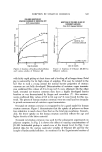
SORPTION BY STRATUM CORNEUM 547 POLYMER SORPTION BY STRATUM CORNEUM OF NEONATAL RAT (0.1% concentration) 2O t• •Y • 10 z o 00 JR-30M o 8 16 24 TIME IN HOURS Figure 3. Sorption of hydroxyethylcellulose and various grades of Polymer JR SORPTiON OF POLYMER JR-400 BY DIFFERENT SURFACES (from 0.1% Aqueous Solution) CLEANED GLASS 0 •" I i I I' I •' 0 8 16 24 TIME IN HOURS Figure 4. Sorption of Polymer JR-d00 by different surfaces with fairly rapid pickup at short times and a leveling off at longer times. Fetal pig is noteworthy for its high values of sorption. This may be related to the fact that in such a young animal the normal barrier properties of stratum corneum are not fully developed. Determination of moisture vapor transmis- sion confirmed this values of 8 to 9 mg/cm'ø/h were obtained. On the other hand, neonatal rat stratum corneum does have a highly developed barrier function as was demonstrated by Singer and coworkers (7). Our measure- ments confirmed this values of 0.2 to 0.4 mg/cm-ø/h were found for this ma- terial. The pieces of human stratum comeurn were too small and foo irregular to permit measurement of moisture vapor transmission. Neonatal rat stratum corneum is recognized to be a good model for human stratum corneum. Figure 1 demonstrates that the uptake of polymer on these two substrates is much closer than that on the fetal pig membrane. Conceiv- ably, the lower uptake on the human stratum corneum reflects the age and higher density of the latter material. Neonatal rat stratum corneum was used for the subsequent experiments on polymer sorption. In Fig. 2 is shown the effect of varying concentrations of JR-125. Substantial pickup is noted even at the lowest level. In Fig. 3 are plotted data for the various molecular weights of Polymer JR and for the sample of hydroxyethylcellulose. As mentioned in the Experimental section of

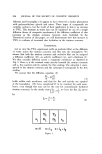
548 JOUBNAL OF THE SOCIETY OF COSMETIC CHEMISTS this paper, sorption is inversely related to molecular weight. The uncharged hydroxyethylcellulose shows very little sorption, representing essentially only a monolayer coverage of the substrate. Sorption of Polymer JR as a Diffusion Process The relatively high amount of polymer uptake by stratum corneum shown in Fig. i to 3 invites speculation about the mechanism involved. In this con- nection, it is relevant to examine first the behavior of Polymer JR on impene- trable inorganic substrates. Adsorption of this polymer (JR-125) from 0.1 per cent aqueous solution onto cleaned glass was measured and yielded values of about 0.25/xg/cm 2. This level of deposition is reached in less than 5 min and does not change with time. Such adsorption corresponds to a covering of one monolayer, if the reasonable assumption is made that each anhydro- glucose unit has an effective area of 25 37, and the adsorbed polymer has a fiat orientation on the surface. In order to make a comparison with skin, the BET surface area of neonatal rat stratum corneum was determined and found to be 0.47 meg, compared to a geometric surface area of 0.113 m2/g. Mono- layer coverage of this substrate would require only about 0.9/xg polymer/mg. It is clear from the data of Fig. i to 3 that the actual uptakes greatly exceed this amount. Figure 4 gives a comparison of the adsorption on glass and stratum corneum on ,qn area basis. The qualitative difference between the two substrate types is striking. The absence of multilayers on glass is presumptive evidence that they do not occur on other substrates. Instead the shape of the sorption curve for neonatal rat stratum corneum suggests that the polymer is slowly being absorbed. In the dry state, neonatal rat stratum corneum has a density of about 0.7. This indicates considerable void space, since the basic keratin of this substrate has a density of 1.4. Additionally, upon immersion in water, the stratum corneum quickly takes up about three to five times its own weight of watery thus providing more aqueous free space for penetration of dissolved species. The data indicate that molecules as large as those of Polymer JR are able to enter the substrate in this way, but probably no further than a few microns in distance. The picture of sorption which emerges corresponds to a semiinfinite solid in contact with a bath containing a constant concentration Co of the diffusing polymer. This is described (8) by the partial differential equation: 0C 02C --D- Ot Ox • with conditions The solution is C = Coat x = 0 for t ) 0 C = Oatt = 0 for x ) 0 C = Co erfc (2•)
Purchased for the exclusive use of nofirst nolast (unknown)
From: SCC Media Library & Resource Center (library.scconline.org)