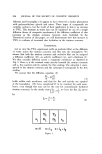
562 JOURNAL OF THE SOCIETY OF COSMETIC CHEMISTS The general structural formulas of the lanolic acid quaternary ammonium derivatives are shown in Fig. 1. The quaternary compounds were prepared from a common amido amine intermediate. This intermediate was prepared by combining equimolar quantities of lanolin fatty acid and diethylamino- propylamine (as shown in Fig. 2.) Conditions for the reaction simply required heating to 150-160øC at first at atmospheric pressure for 2h, and finally under reduced pressure (0.1 mm Hg) for a period of about 3-4 h. The extent of re- action was followed by measuring evolved water and by a combination of acid and amine values. The diamine required for reaction with the lanolin acid to form the inter- mediate must be a diamine having one of its nitrogen atoms bearing two sub- stitutes (as shown in Fig. 3). In other words, one of the nitrogens of the diamine is a tertiary amine with no site available for reaction. The other ni- trogen of the diamine is either a primary or a secondary amine and thus it becomes available, via one of its hydrogens, for reactions with a lanolin acid (11). The quaternization of the amidoamine was carried out by combining equi- molar quantities of the intermediate with a suitable quaternizing agent and heating to 110-120øC at atmospheric pressure for a period of about 4 h. The extent of reaction was measured by the decrease in amine value (reac- tions are shown in Fig. 4). The choice of benzyl chloride as a quaternizing agent was based on the fact that analogous types of quaternaries are among the most common and com- parisons to existing products could be made easily, without the fear of another variable. The choice of diethyl sulfate as the other quaternizing agent was more or less arbitrary, and any other suitable materials such as aliphatic hal- where x- 2 p.,, = H or Below tlL K J,'I. z 0oet1N1 M- or' O,RBOOYlO Figure 3. Required aliamine.

II•ToeRHEDIAToe NEW LANOLIN QUATERNARY SALTS BENZ¾1 oeHLORIDoe 563 i NToe RMI•DIAT• _jso C DIoeTHYL 5ULFA TE L C,H J R = Lan/I '•I-EHzE, I-tzCH•. H Figure 4. Quaternization TABLE II Typical Properties of Quats [ e LanBAC Stearalkonium LanES Quarternium 7 Chloride Amber Creamy White Amber Very Cream Colored Form Semisolid Dispersion Viscous Liquid Dispersion Active content 81.9% 16.0% 76.3% 79.7% Total chloride content 5.8% - N/A 7.8% pH (1% aqueous sol'n) 6.2 3.0-4.0 5.0 3.4 Surface tension 41.4 34 40.3 -- (1% aqueous sol'n (@ 25øC) dynes/cm dynes/cm dynes/cm Ross Miles Foam Data-- Initial: 100 mm 50 mm 150 mm 150 mm After 5 min: 80 mm 40 mm 110 mm 130 mm ides, aromatic halides, or other aliphatic alkylating agents, such as ethylene chlorohydrin, could have been used. Among such halides and esters which may be used are methyl chloride, methyl bromide, butyl bromide, di-methyl sulfate, and the like (11). The resulting experimental lanolin quaternaries are dark amber materials ranging in viscosity from a thick liquid for the ethosulfate derivatives, to a hard brittle solid for the benzyl chloride derivative. Since these quaternium
Purchased for the exclusive use of nofirst nolast (unknown)
From: SCC Media Library & Resource Center (library.scconline.org)