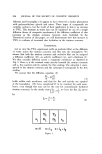
556 JOURNAL OF THE SOCIETY OF COSMETIC CHEMISTS Osborne and Gerraughty (4) appear to have observed a similar phenomena with polyoxyethylene glycols and esters. These types of compounds are certainly occlusive, but the result of their application to skin is an increase in TWL. This increase in water loss can be explained by use of a simple diffusion theory of composite membranes if the diffusion coefficient of skin increases as the stratum corneum becomes more hydrated. In the Theoretical section of this paper, we will demonstrate how this increase in TWL is evidence of increased skin hydration in the stratum corneum. THEORETICAL Let us view the TWL experiment (with an occlusive film) as the diffusion of water across the stratum corneum and film into the atmosphere. We assume that both the stratum comeum and occlusive film can be assigned a diffusion coefficient (D), an activity coefficient (7), and a thickness (1). We thus consider diffusion across a composite membrane as depicted in Fig. 1. Here, ai is the constant water activity beneath the stratum corneum and ao the constant activity outside the thin coating. The subscript 1 corre- sponds to the stratum comeum and the subscript 2 corresponds to the thin coating. We assume that the diffusion equation (5) 0c 02c - D- Ot 0x" (1) holds within each membrane, and that the flux and activity are equated at the boundaries. (We have considered D to be constant for each mem- brane, even though this may not be the case for nonuniformly hydrated stratum corneum.)In the steady state(0c ) we have the flux (J•)given by J's-- ai--ao Otl -, oz,, (P•) a i x=O x=l 1 x=11+l 2 Figure 1.

DIFFUSION ANALYSIS THROUGH OCCLUSIVE FILMS 557 where aj = 1j%. A measure of the hydration (water content) per unit area D.i of stratum corneum during steady-state diffusion can be obtained by inte- grating the concentration across the stratum corneum. This amount (Q) of water per unit area of stratum eorneum is given by a, 1 1 Q = dx Cs l) (X) = ai -- 0 yx ao 2(1 + ae/a•) (3) where csO) (x) is the steady-state concentration in the stratum corneum and is given by ¾•cs(. (x) = L[-• + -,(1- x/h)] + ao (4) Let us suppose that the diffusion coefficient for stratum corneum is de- pendent upon hydration. According to Scheuplein and Ross (6), this varia- tion can be greater than an order of magnitude for zero and 100 per cent relative humidity outside the skin. Grice et al. (7) also give evidence (TWL measurements ) that diffusion is dependent on hydrahon. We can now use equations (2) and (3) to predict the effect of a film on the hydration of the stratum corneum and flux (TWL). We assume that ao is near zero, and thus, have "dry" diffusion when the film is absent (as = 0). Thus js a _ ai -- ao ad (5) and Q• =_•(at+ a,,) 1 1• a• • ~• •- (6) where the superscript d corresponds to the nonoccluded case. For perfect occlusion (o•2- • ), we have J•0 (7) and •1 ai y• (8) where Qm is the mmximum hydration. If a2 is not all that different from we have an intermediate case. For a viscous hydroc•bon, we can •sume • De • 10 -s cm=/sec, 1• • 40•m, and y2/% • 10, •d for the stra•m cor- neum (8), let D•w• 10 -• cm=/sec, and 1• • 10•m. Thus, we have a=/a• w *The diffusion coefficient for a viscous hydrocarbon is approximated from the Stokes- Einstein equation, D=kT/6•rvr where k is Bo]tzmann's constant, T is temperature (30øC), is the hydrocarbon viscosity (taken to be 5aP as for castor oil), and r is the radius of water (taken to be 3A). The ratio %/% is bit uncertain, but since skin hy- drates well and water is not very soluble in hydrocarbons, a ratio of ten is not unreason- able.
Purchased for the exclusive use of nofirst nolast (unknown)
From: SCC Media Library & Resource Center (library.scconline.org)