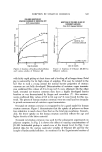
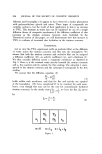
558 JOURNAL OF THE SOCIETY OF COSMETIC CHEMISTS ~ 4, where a• w corresponds to the "wet" diffusion situation, i.e., D• ~ 10 -'• cm2/sec. If we assume that al a = 10 al 'v, we have and j2 v _ ai -a•o _ 2Ja (9) 50•1 w ai+¾o ~0.9 (10) Hence, we see that for a film that is sufficiently oeelusive such that a2= 4al, we can hydrate the skin to within 90 per cent of maximum hydration. This increased hydration can then give rise to an increase in flux or TWL, which is consistent with •e observed rise in TWL upon application of petrolatum to skin. In fact, from this analysis, a rise in TWL with an oeelusive film is good evidence that the stratum comeurn is being hydrated. CONCLUSION It has been obse•ed •ha• •he insensible water loss o• skin can increase when •reated wi•h occlusive agents. This increase is a logical consequence o• the increase in dieusion coe•cien• o• s•ra•um comeurn when it becomes hydrated. These resuks sugges• tha• evaluation o• cosmetic •ormulations on the bask o• •heir e•ec• on in vivo insensible wa•er loss could easily be mis- leading wi•h respect •o skin conditioning. That is, a material which gives an increase in TWL may indeed be hydrating •he skin •o within a •ew percent o• maximum hydrafion, •nd should not be eliminated as a poor conditioner on •hese grounds. ACKNOWLEDGMENT We wish to thank J. S. Berry of The Procter & Gamble Company for pro- viding the TWL data on skin treated with petrola•m. (Received June 10, 1975) REFEREN•S (1) I. H. Blank, Proc. Sci. Sect. Toilet Goods Ass., 23, 19 (1955). (2) P. Flesch, Amer. Per. Cosmet., 77, 77 (1962). (3) I. H. Blank, J. Amer. Med. Ass., 164, 412 (1957). (4) G. E. Osborne and R. J. Gerraughty, J. Soc. Cosmet. Chem., 12, 271 (1961). (5) J. Crank, The Mathematics o[ Diffusion, O•ford U. Press, London, 1957. (6) R. J. Scheuplein and L. W. Ross, J. Inve•. Dermatol., 62, 353 (1974). (7) K. Gri•, H. Sattar and H. Baker, J. Inve•. Dermtol., 58, 343. (1972). (8) R. J. Scheuplein, U.S. Department of Cornmere, Repo• AD 822 665.

I. Soc. Cosmet. Chem., 27, 559-570 (November 1976) New Lanolin Acid Quaternary Salts for use in Hair Treatment Preparations JUSTIN P. MCCARTHY, B.S.,* LEE R. MORES, M.S.* and MITCHELL L. SCHLOSSMAN, B.S.* Presented May 29, 1975, Annual Seminar, St. Louis, MO. Synopsis.' The action of QUATERNARY AMMONIUM SURFACTANTS on HAIR has been studied for many years. Several of the characteristics, which are important in formulating with these SALTS, are dependent upon their molecular configuration. In this paper, lanolin compounds which essentially comprise QUATERNARY DERIVATIVES (QUATS) of LANOLIN ACIDS are described. The preparation of a derivative of lanolin consisting essentially of the reaction product of a lanolin a,cid and a specific diamine followed by quaternization is outlined. The chemical and physical properties of quaks are briefly reviewed and compared with emphasis on these new lanolin a•d derivatives, and their chemistry and processing is highlighted. Each of these quaternary salts was incorpo- rated into hair conditioning preparations and evaluated on human hair. INTRODUCTION It has been known for a long time that quaternary ammonium surfactants display many unusual and desirous properties and functions (1). Much work has been done demonstrating germicidal activity (5), softening effects (2, 3), antistatic properties (4), substantive qualities, and other uses of these mate- rials. Many of these properties find applications in cosmetics, where quater- nary ammonium compounds are useful as preservatives (5), hair conditioning agents (6), emulsifiers (7), etc. However, it has long been known that these materials possess a relatively high level ot• toxicity both to the skin and eyes (8). Also, they have a low comparability level with other commonly used cosmetic materials-specifically anionic emulsifiers and surfactants (9). *Maimstrom Chemicals, Cosmetic Specialties Group, Emery Industries, Inc., 1501 W. Elizabeth Ave., Linden, N.J. 07036. 559
Purchased for the exclusive use of nofirst nolast (unknown)
From: SCC Media Library & Resource Center (library.scconline.org)