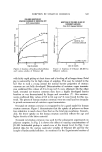
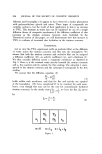
SCANNING ELECTRON MICROSCOPY 527 To gain a better insight into the changes that do occur, if any, we have developed a method for cross-sectioning (see Experimental section) positive skin replicas to rew•al in cross-sect/on the profile of the topography of the skin surface (Fig. 8). We have seen "effects", namely a dramatic (apparent) smoothing, when an occlusive layer, such as a typical lotion, is applied (such as Figure 6(b)). In other words, when the "valleys" of the topography are filled in (or a cov- ering layer has been applied), we can demonstrate a definite effect on cross- section replicas. However, for the more subtle case, where the effect is due primarily to a reduction in the number of uplifting layers (such as Figs. 4 and 7), the cross-sectional veiws have not been particularly useful. DISCUSSION It is clear that the scanning electron microscope, when used to photograph replicas of human skin, can Be a powerful tool for evaluating the efficacy of skin care products. By associating the concentration and size of the uplifting layers with skin quality, we can assess the long (or short) term benefit of a particular cosmetic formulation. An example of the type of quantitation that is possible is demonstrated in Figs. 9, 10, and 11, where we have the same replica sequence used in Fig. 6 (BEFORE, AFTER 1 h, AFTER 5 h,), except at slightly lower magnifica• tion. Figure 9 shows the original montages Fig. 10, the montages with what we call "marked overlays" and the "marked overlays" are shown alone in Fig. 11. What we are really doing is marking on the overlay all bad areas as de- fined by uplifting layers. The larger the blackened are'as, the worse the skin condition. In this fashion, it then becomes possible to quantirate the degree of improve- ment and follow how long the effect persists. The ultimate question is still with regard to "moisturizing." From our data, it would appear that the action of most typical moisturizers is to penetrate into (but not necessarily through) the stratum eorneum, plasticizing the other- wise dry horny layer. Whether we are speaking specifically of humeetants, occlusive 1ipids, or something as mundane as mineral oil, the mechanism seems to be the same, namely a covering, which is then followed by a diffu- sion of the topically applied materials into the layers of the stratum corncure. Once so swollen, a combination of surface tension effects (which keep the uplifting layers ttattened down on the plane of the horny layer) and lubrica- tion effects lead to the perceived clinical effects. Some materials, such as Co]lasol, certain proteins, and eellulosie-derived polymers may work primarily by binding water to the top surface, after which the surface tension effects dominate. Cle,arly, without the presence of an oily layer, such materials could accomplish the desired clinical effects without being greasy at the same time. In general, however, for the typical moisturizing product presently on the

528 JOURNAL OF THE SOCIETY OF COSMETIC CHEMISTS (a) (b) (o) Figure 9. SEM montages showing: (a) before, (b) after i h, and (c) after 5 h applying typical connnercial h,'md lotion. Scale bars represent 330 t•m market, although water may be involved, the primary effect is due to the oils and additives other than water. CONCLUSION SEM on in vivo skin replicas made as BEFORE and AFTER pairs from the same identical area of stratum corneum demonstrate that beneficial clinical
Purchased for the exclusive use of nofirst nolast (unknown)
From: SCC Media Library & Resource Center (library.scconline.org)