560 JOURNAL OF THE SOCIETY OF COSMETIC CHEMISTS It was our goal in this study to develop a quaternary ammonium derivative, which would be less irritating, and yet, as chemically active as other common quaternaries presently used for hair treatment in the cosmetic industry. In this paper, we will chemically describe some new quaternary ammonium compounds, which are derived from a well established nonirritating (10) highly emollient material-lanolin acids. We will discuss some of their prop- erties, specifically eye irritation, germicidal activity, and solubilities. Also, studies comparing two lanolin acid quaternaries with some other commercial- ly used quaternary ammonium compounds in a shampoo and a cream rinse formulation involving salon testing of human hair will be presented. CHEMICAL DESCRIPTION Lanolin, which is extensively used in cosmetic compositions, is generally considered to consist of a mixture of naturally formed esters derived from higher alcohols and higher fatty acids. By saponifying the lanolin esters with alcoholic alkali, one can separate the alkaline soaps of lanolin acids from the unsaponifiable portion containing lanolin alcohols. By acidification of the alkaline soaps, crude lanolin acids o[ the composition shoxvn in Table I are ob- tained. These acids are refined through a distillation and deodorization pro- cess described in a U.S. patent.* The acids are then bleached or decolorized. Table I LANOLIN ACIDS: o La n C. OH where 'Lan' represents: n-alkanoic acids iso-alkanoic acids anti-iso-alkanoic acids hydroxy-alkanoic acids unidentified % 7 23 30 28 12 lOO% *Richey, et al., Pat. •P3, 272, 850.

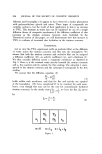
NEW LANOLIN QUATERNARY SALTS 561 OI•oetlYL-&tAINOP•OPVoe Li•NOZI• AOID-•:tVZYL-&t•MONIglt• - CzHs TRIoeTttYI-- AMINOP•OpyI LANOLIC ACID- oeTttOSUL IRATE Figure 1. Structures of lanolin quaterniums o H Lai½'OH + N-CH2(2HzO, H-N % H CzHs z.•lVO• l/V tlo105 01oe TH YL. - tl MIN O - Poe O pyl - tM• INE o ,, •Cz¾15 L8•1 '½' N-CHe C,I-leCI'I•- • H / •CzH5 * A MID O•q/•llN&' INTERM•CDIATE F•gure •. •eparation oz c intermediate Apparently, the refining procedure eliminates a number of the more than 40 acids, which compose the crude lanolin acids. At any rate, the thus refined lanolin acids react with the amines described below and are then converted to the quaternary ammonium derivatives, which are also discussed below.
Purchased for the exclusive use of nofirst nolast (unknown)
From: SCC Media Library & Resource Center (library.scconline.org)