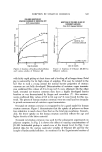
SORPTION BY STRATUM CORNEUM 549 where erfc (x) is the "error function complement:" erfc(x) = 1 •I x o The data obtained here do not correspond to concentrations at differing dis- tances in the substrate, but to total material absorbed at varying times. We thus need the integral of the above solution over unit surface of the mem- brane: Q= oC(x,t)dx=Co erfc(••dx o \ 2VDt / By virtue of this becomes rfc (u) du - Q = 2Co •J Dt This well-known formula was quoted without derivation in a classical pa- per (9) on the diffusion of small molecules in animal tissues. A test of the validity of this approach is that sorption should follow a square-root of time dependence. This was indeed generally found to be the case for the experiments reported here, at least for the first several hours. At longer times, particularly over i day, deviations from 5/• do occur. By using Hill's formula above, diffusion constants can be calculated from the slope of the initial, linear part of the Q versus 5/• curves. An area of 0.47 m2/g was assumed in all cases corresponding to the observed BET area rather than the calculated geometric areas. Calculations were made for some of the more interesting cases. For example, the data of Fig. i gave the fol- lowing table. Type of Stratum Corneum Diffusion Constant (cm2sec) Fetal Pig 9.6 x 10 -9 Neonatal rat 1.07 x 10 -•ø Human 7.8 x 10 -• The different grades of Polymer JR in neonatal rat stratum corneum at 0.1 per cent concentration (Fig. 2) led to the following table. Grade Diffusion Constant (cm2/sec) JR-125 1.07 x 10 -•ø JR-400 9.7 x 10 -• JR-30 M 1.2 x 10 -•"

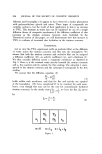
550 JOURNAL OF THE SOCIETY OF COSMETIC CHEMISTS SORPTION OF POLYMER JR-125 BY NEONATAL RAT STRATUM CORNEUM - INFLUENCE OF ADDED SALTS NO SALT •,15 •: 10 • 0.01 M NaCl -0 8 16 24 TIME IN HOURS Figur• 5. Effect o[ sa]ts on the sorption o[ Polymer ]R-125 EFFECT OF SOLVENT ON SORPTION OF POLYMER JR-125 BY STRATUM CORNEUM OF NEONATAL RAT 20 •o 15 lO ,•z 5 I I øo 8 16 24 TIME IN HOURS Figure 6. Effect of solvent on the sorption of Polymer ]R-125 These values are for the diffusion of polymer in the membrane medium, and are only valid for the first few hours of the sorption process. It is of interest to compare these numbers with the aqueous diffusion of the polymer. No specific value has yet been determined for that process, but an estimate can be made by eousidering the diffusion constant of the chemically related poly- mer HEC. A sample of HEC of tool wt 330,000 (about the size of Polymer JR-125) has a diffusion constant of 1.1 x 10 -? cm'-'/sec (6). This can be re- garded as a lower limit for the aqueous diffusion of JR-125, which as a polyelectrolyte, should diffuse even faster than if it were uneharged (10). It is evident that the membrane diffusion is orders of magnitude slower than aqueous diffusion a similar observation was made long ago by Hill (9). For long times, the diffusion in the membrane slows considerably, evi- denced by a decreasing slope of the Q versus •/•-plot. This was also demon- trated by experiments with a permeability cell modeled after that of Love- day (11). A 1 per cent solution of radio-tagged Polymer JR-125 was placed above an intact piece of neonatal rat stratum eorneum and stirred distilled water was placed below. Samples were taken from the bottom of the eel] at periodic intervals for counting analysis. No mea•surable passage of polymer occurred through the membrane in 2 weeks. From the familiar time lag for-
Purchased for the exclusive use of nofirst nolast (unknown)
From: SCC Media Library & Resource Center (library.scconline.org)