572 JOURNAL OF THE SOCIETY OF COSMETIC CHEMISTS body. In tactile evaluation, a mass of loose hair is usually compressed and relaxed, if it is firm and resilient, the rating is positive. While considerablc differences exist both in methods and ratings, a common characteristic can be found in all cases: hair body is associated with mass structural strength and resiliency. On the basis of this, it is proposed that: body is a measure of a hair lnass's resistance to, and recovery from, externally induced deformation. Some of the words of this definition nmst be emphasized. First, body always refers to a hair mass even if one may extrapolate to it from single fiber properties. Secondly, body is a quantitative characteristic and, therefore, the word measure must be included in the definition. Hair with no body means that some or all of the fttndamental parameters which contribute to the mass strength are present at low levels only. The above definition satisfies the characteristics which are judged by the visual method of body determination according to the following. The emerg- ing angle of hair fibers is high in relation to the skin. Consequently, the fibers would keep pointing in a substantially radial direction with regard to the skull in the absence of outside forces. The continuously acting external modifier is the gravitational force. Depending on the balance between structural strength and resiliency of the hair on one hand, and the gravitational load on the other, the hair mass may show more or less elevation bulkiness. The word bulkiness is used here in terms of its textile definition, meaning low structural density. In connection with the hand compression method of body evaluation, it is evident that strength and resiliency characteristics are appraised and, there- fore, it fits the above given definition for body as well. B. Component Factors in Hair Body The above definition equates body with the resilient strength of a hair mass under static and dynamic conditions. The resilient strength of any multicom- ponent engineering structure, which a hair mass is, is influenced by a number of independent parameters. In the most basic form, five such parameters need to be considered: fiber density on the scalp bending and torsional stiffness and resiliency of fibers fiber diameter fiber configuration and fiber-fiber interactions. 1. Fiber density on scalp: Fiber density is an important factor in modifying both structural volume and resiliency of hair mass over and at the sides of the head. When all other factors are equal, the volume of a fibrous mass is a linear function of the number of fibers in it. This correlation is satisfactory to indicate the direction of the influence, but it must not be applied quantita- tively to the elevation of hair over the head. The main reason is that the hair mass density decreases with increasing distance from the skin for any fiber density at the roots. The structural stabilization-originating from fiber-fiber

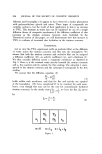
HAIR BODY 573 interactions and fiber stiffness-decreases with the density. Complete mathe- matical models, incorporating all variables, are not yet available. When only the density gradient is taken into account, it is easy to show that the fiber mass elevation increases with the square root of the hair density at the skin level. The increasing structural resiliency of a denser head of hair can be asso- ciated with the following facts: the number of contact points between fibers is higher and the segmental fiber length between supporting contact points is lower. In addition, the angie of contact bet•veen neighboring fibers is lower in regions near the scalp. For these reasons, a larger portion of the lead is sup- ported by material compression, instead of bending or torsional resistance of the fibers. The most closely fitting industrial example for the importance of fiber density in a loose fibrous mass is that of a pile carpet. The packing density is of great importance for the resilient strength of these structures. While the on-head fiber density influences the visual hair body evaluation very strongly, it is probably a secondary characteristic in the hand compres- son method which measures intrinsic parameters for the mass structure. 2. Bending and torsional stiffness and resiliency: The second group of parameters for hair body involves mechanical characteristics-specifically the modulus and yield stress-of the component fibers in bending and torsional modes. Tensile behavior does not play a significant role in hair body. The weight of even a 100-cm long fiber is in the 10 -a g range. This is 3 to 4 orders of magnitude smaller than the yield force of an average fiber in the dry state. However, this lead is more than enough to cause torsional and especially bending deformations. The bending deformation gains added im- portance as it increases with the third power of the segmental length of a beam, which a fiber represents: S--k---- (1) where S equals bending flexure k equals numerical constant f equals force 1 equals length of beam M equals Young's modulus and r equals radius of beam. A second characteristic within this group is the resiliency of the fibers, de- scribing the balance between elastic and plastic behavior. Overall, the higher the stiffness and resiliency of the fibers, the higher the body of the hair mass, when other characteristics are equal. 3. Fiber diameter: This parameter often reaches a dominant position, be- cause as mentioned before, hair body is associated mostly with torsional and bending deformations of the component fibers. Both the bending and the
Purchased for the exclusive use of nofirst nolast (unknown)
From: SCC Media Library & Resource Center (library.scconline.org)