I. Soc. Cosmet. Chem., 27, 559-570 (November 1976) New Lanolin Acid Quaternary Salts for use in Hair Treatment Preparations JUSTIN P. MCCARTHY, B.S.,* LEE R. MORES, M.S.* and MITCHELL L. SCHLOSSMAN, B.S.* Presented May 29, 1975, Annual Seminar, St. Louis, MO. Synopsis.' The action of QUATERNARY AMMONIUM SURFACTANTS on HAIR has been studied for many years. Several of the characteristics, which are important in formulating with these SALTS, are dependent upon their molecular configuration. In this paper, lanolin compounds which essentially comprise QUATERNARY DERIVATIVES (QUATS) of LANOLIN ACIDS are described. The preparation of a derivative of lanolin consisting essentially of the reaction product of a lanolin a,cid and a specific diamine followed by quaternization is outlined. The chemical and physical properties of quaks are briefly reviewed and compared with emphasis on these new lanolin a•d derivatives, and their chemistry and processing is highlighted. Each of these quaternary salts was incorpo- rated into hair conditioning preparations and evaluated on human hair. INTRODUCTION It has been known for a long time that quaternary ammonium surfactants display many unusual and desirous properties and functions (1). Much work has been done demonstrating germicidal activity (5), softening effects (2, 3), antistatic properties (4), substantive qualities, and other uses of these mate- rials. Many of these properties find applications in cosmetics, where quater- nary ammonium compounds are useful as preservatives (5), hair conditioning agents (6), emulsifiers (7), etc. However, it has long been known that these materials possess a relatively high level ot• toxicity both to the skin and eyes (8). Also, they have a low comparability level with other commonly used cosmetic materials-specifically anionic emulsifiers and surfactants (9). *Maimstrom Chemicals, Cosmetic Specialties Group, Emery Industries, Inc., 1501 W. Elizabeth Ave., Linden, N.J. 07036. 559

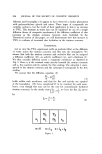
560 JOURNAL OF THE SOCIETY OF COSMETIC CHEMISTS It was our goal in this study to develop a quaternary ammonium derivative, which would be less irritating, and yet, as chemically active as other common quaternaries presently used for hair treatment in the cosmetic industry. In this paper, we will chemically describe some new quaternary ammonium compounds, which are derived from a well established nonirritating (10) highly emollient material-lanolin acids. We will discuss some of their prop- erties, specifically eye irritation, germicidal activity, and solubilities. Also, studies comparing two lanolin acid quaternaries with some other commercial- ly used quaternary ammonium compounds in a shampoo and a cream rinse formulation involving salon testing of human hair will be presented. CHEMICAL DESCRIPTION Lanolin, which is extensively used in cosmetic compositions, is generally considered to consist of a mixture of naturally formed esters derived from higher alcohols and higher fatty acids. By saponifying the lanolin esters with alcoholic alkali, one can separate the alkaline soaps of lanolin acids from the unsaponifiable portion containing lanolin alcohols. By acidification of the alkaline soaps, crude lanolin acids o[ the composition shoxvn in Table I are ob- tained. These acids are refined through a distillation and deodorization pro- cess described in a U.S. patent.* The acids are then bleached or decolorized. Table I LANOLIN ACIDS: o La n C. OH where 'Lan' represents: n-alkanoic acids iso-alkanoic acids anti-iso-alkanoic acids hydroxy-alkanoic acids unidentified % 7 23 30 28 12 lOO% *Richey, et al., Pat. •P3, 272, 850.
Purchased for the exclusive use of nofirst nolast (unknown)
From: SCC Media Library & Resource Center (library.scconline.org)