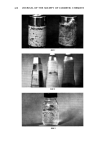
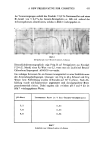
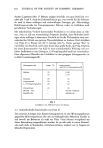
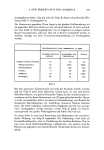
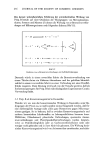
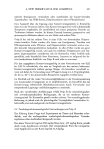
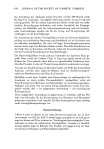
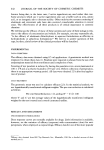
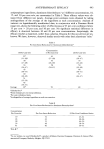
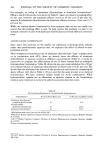
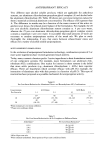
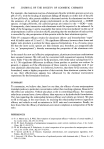
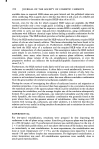
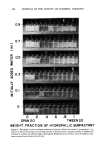
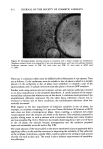
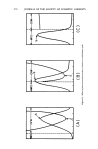
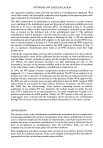
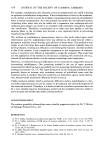
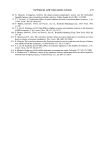
472 JOURNAL OF THE SOCIETY OF COSMETIC CHEMISTS -, • ...i :' ?' ' ... :5::" ß •' . .•-•-.,.: . : , ,.. .= .• • .... .. •.• .... . .: .• . . .., -' -• ..•.. • . 5. -., . Figure 10. Microphotographs showing mineral oil emulsions with 2 distinct droplet size distributions. (Emulsion contains 30 per cent mineral oil, 65 per cent &ionized water, and 5 per cent surfactant mixtures. Surfactant mixtures consist of POE (10) oleyl ether and POE (2) oleyl ether at 40/60 ratio) (x 1200) There are 3 conditions which must be fulfilled before Mechanism A can operate. They are as follows: (1) the surfactants must be soluble in the oil phase in which it is initially placed (2) the surfactants in the oil phase must solubilize or emulsify a part of the aqueous phase and (3) a phase inversion must take place to form an O/W emulsion. Further work using various oils and nonionic, anionic, and cationic surfactants resulted in no data contradictory to the proposed hypothesis. A careful analysis of the experi- mental data indicates that wherever any of the above 3 conditions were promoted, the emulsification efficiency improved. On the other hand, whenever a factor was in- troduced to hinder any of these conditions, the emulsification efficiency often dra- matically decreased. With regards to the first requirement of surfactant solubility in the oil phase, for example, an oil phase containing 14.3 per cent Tween 80/Arlacel 80 mixture at 80/20 ratio does not form a homogeneous phase. Upon standing, a surfactant-rich phase would separate from the mixture and settle to the bottom. The emulsion, prepared by quickly adding water to such a mixture with a moderate mixing, had coarse droplets and was unstable (Fig. 9(A)). However, by initially dispersing about 2 per cent of water in the oil phase, the mixture became homogeneous and the emulsion prepared improved remarkably as can be seen in Fig. 9(B). The small amount of the water added to the above mentioned mixture apparently had a significant effect on the miceliar structure in improving the solubility of the surfactant in the oil phase. Sometimes a similar effect could be achieved by adding a small amount of polar oils such as oleic acid. The result is also a definite improvement of emulsifica- tion efficiency.

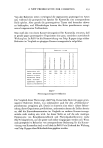
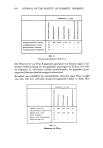
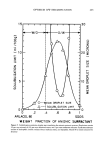
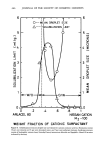
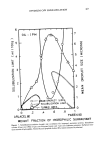
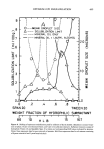
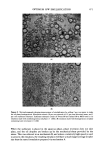
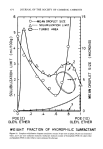
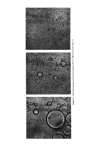
OPTIMUM O/W EMULSIFICATION 473 Another example is a mixture of POE (10) oleyl ether/POE (2) oleyl ether at 40/60 ratio in mineral oil.* If an emulsion is prepared by immediately emulsifying the oil- surfactant mixture right after dispersion, a reasonably fine emulsion is obtained. However, if the oil-surfactant is allowed to stand overnight, it would separate into two layers--the lower oil layer containing most of the surfactant and the top oil layer containing much less surfactant. If an emulsion is prepared with such a two-layered oil phase, the emulsion would contain fine droplets derived from the lower surfactant-rich layer and coarse droplets originated from the upper, surfactant-poor layer. A microphotograph of such an emulsion revealing 2 distinct droplet size distributions is shown in Fig. 10. The second requirement for the emulsification mechanism is related to the aqueouo solubilization by the oil phase. From the experimental results presented so far, it is quite apparent that water solubilization must be related to emulsification efficiency. Other factors being equal, a larger quantity of water solubilization appeared to favor formation of a finer emulsion, although, the quantity of solubilization by itself cannot be regarded as an absolute measure of emulsification efficiency. Although it is quite possible that a great water solubilization merely indicates the area of favorable condition for emulsification, there is also experimental evidence suggest- ing that solubilization is one of the necessary steps in the over-all emulsification process. In many systems studied, it was possible to improve emulsification by initially presolubilizing the water into the oil-surfactant mixture before emulsification. For example, a combination of 2- and 10-mole adducts ofoleyl ethers in mineral oil forms a fairly complex solubilization diagram as shown in Fig. 11. When an emulsion was pre- pared in the usual manner using an 80/20 surfactant mixture indicated by a letter "X" in the diagram, the droplets were very coarse and the emulsion unstable. Subsequently, the emulsification procedure was slightly modified by first dispersing and solubilizing a small amount (2.6 per cent) of water into the oil phase to bring the mixture to point "Z" in the diagram. The resulting emulsion was very stable and had a very fine droplet size as shown in the photograph in Fig. 12 (Z). Another similar presolubilized emulsification was carried out with a slightly reduced amount of initial water (2 per cent instad of 2.6 per cent) corresponding to point "Y" in the turbid area of Fig. 11. The result was an emulsion somewhat better than that of point X, but much inferior to the emulsion prepared at Z. Since all three emulsions, X, Y, and Z have an identical, final composition, it must be concluded that the presolubilization treatment and the amount of the presolubilized water were positively affecting the emulsification process. In dispersing the water into this oil-surfactant mixture, it was noted that the water was not solubilized instantly, but it required time and considerable amount of mixing work before complete solubiliza- tion was obtained. This would suggest that, perhaps, the rate of water solubilization too is an important factor in emulsification. It can be explained that when one starts emulsification from the point X by quickly adding water, even though, compositionwise, the mixture will pass points Y and Z, be- cause of the very slow rate of solubilization, it is not possible for the mixture X to reach *The total surfactant mixture was 14.3% in the oil phase.
Purchased for the exclusive use of nofirst nolast (unknown)
From: SCC Media Library & Resource Center (library.scconline.org)