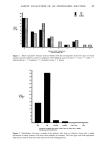
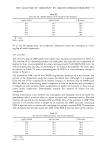
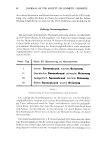
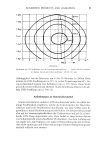
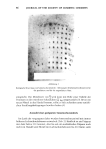
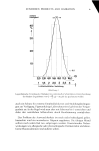
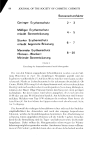
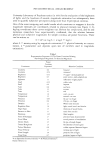
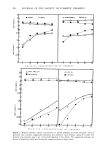
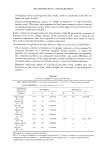
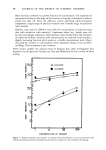
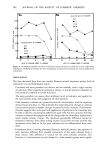
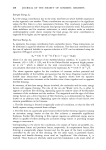
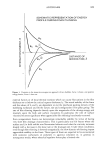
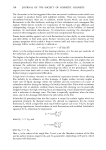
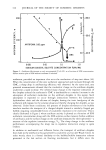
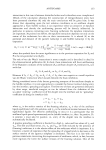
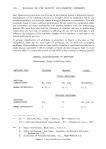
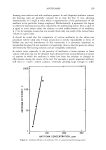
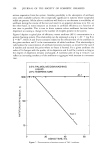
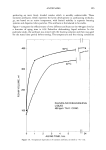
PSYCHOPHYSICAL MEASUREMENT 93 University Laboratory of Psychoacoustics (in 1953) for the evaluation of the brightness of lights and the loudness of sounds, magnitude estimation has subsequently been used to quantify subjective perceptions along more than 36 perceptual continua. One of the most intriguing and useful results which continues to reappear is that the magnitude estimates are curvilinearly related to physical intensity (see Figure 1). In log-log coordinates these curves straighten out. Stevens has conjectured, and he and numerous researchers have experimentally confirmed, that the relation between physical and subjective magnitudes for simple continua are power functions. These can be written as: S = kI r• (or, log S •- n log I d- log k) where S = sensory rating by magnitude estimation, I = physical intensity or concen- tration, k = paramenter and depends upon size of numbers used in magnitude estimation). Table I Representative Exponents Of The Power Functions Relating Psychological Magnitude To Stimulus Magnitude Continuum Power Function Exponent • Stimulus Condition Loudness 0.6 Loudness 0.54 Brightness 0.33 Brightness 0.5 Lightness I 2 Smell 0.55 Smell 0.6 Taste 0.8 Taste 1.3 Taste 1.3 Temperature 1.0 Temperature 1.5 Vibration 0.95 Vibration 0.6 Duration 1.1 Repetition Rate 1.0 Finger Span 1.3 Pressure on Palm 1.1 Heaviness 1.45 Force of Handgrip 1.7 Vocal Effort 1.1 Electric Shock 3.5 Tactual Roughness 1•5 Tactual Hardness 0.8 Visual Velocity 1.2 Visual Length 1.0 Visual Area 0.7 binaural monaural 5 ø target--dark-adapted eye point source--dark-adapted eye reflectance of gray papers coffee odor heptane saccharin sucrose salt cold--on arm warmth--on arm 60 cps--on finger 250 cps--on finger White-noise stimul us light, sound, touch and shocks thickness of wood blocks static force on skin lifted weights precision hand dynamometer sound pressure of vocalization 60 cps--through fingers felt diameter of emery grits rubber squeezed between fingers moving spot of light projected line of light projected square of light •N in Expression Sensory Intensity = K(Physical Intensity) N. Source: Stevens (2).

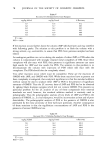
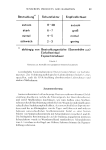
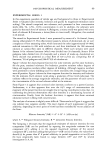
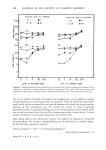
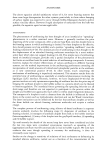
94 JOURNAL OF THE SOCIETY OF COSMETIC CHEMISTS The values for n range from very low ones (around 0.2-0.3 for some odorants in a liquid diluent) to very high ones (more than 2.0 for the perceived shock produced by electric current). Table I presents a summary of some of the power function exponents (2). USING FUNCTIONAL RELATIONS Psychophysical equations, such as the power function obtained by direct magnitude estimation, provide the cosmetic chemist with a powerful tool for correlating known physical modifications in a product with subjective responses to those changes. For example if the experimenter has systematically varied the concentration of a fragrance in a base (e.g., aerosol base), he can develop a curve relating the concentration of the fragrance versus the perceived odor intensity (or even versus the perceived strength of one or another specific note in the fragrance, as well as liking/disliking of the fragrance). Furthermore, if the experimenter allows the panelist to apply a fragrance to her arm or to her face, and then has the panelist evaluate the fragrance intensity over a period of several hours, he can trace out, quantitatively, the loss of fragrance intensity with increasing time on the skin. The curves can be used to indicate the following: the expected sensory shift (in percentage or ratio value) for a given percentage increase (or decrease) in the concentration of fragrance oil and the expected percentage sensory shift in fragrance intensity for a given percentage increase in the time that the fragrance remains on the skin. Table II Some Power Function Exponents Odorant Exponent Diluent 1. Amyl Acetate 0.13 Liquid 2. Anethole 0.16 Liquid 3. 1-Butanol 0.31 Liquid 4. 1-Butanol 0.64 Air 5. 1-Butanol 0.66 Air 6. Butyl Acetate 0.58 Air 7. Butyric Acid 0.22 Liquid 8. Coumarin 0.33 Air 9. Citral 0.17 Liquid 10. Ethyl Acetate 0.21 Liquid 11. Eugenol 0.27 Liquid 12. Eugenol 0.64 Air 13. Geraniol 0.20 Air 14. Guaiacol 0.20 Liquid 15. 1-Heptanol 0.16 Liquid 16. 1-Hexanol 0.15 Air 17. D Menthol 0.24 Liquid 18. Methyl Salicylate 0.20 Liquid 19. 1-Octanol 0.24 Liquid 20. 1-Pentanol 0.21 Liquid 21. Phenylethyl Alcohol 0.19 Liquid 22. Phenyl Acetic Acid 0.12 Liquid 23. 1-Propanol 0.52 Air 24. Iso-valeric Acid 0.21 Liquid Source: Berglund, Berglund, Ekman & Engen (3) and Moskowitz (4).
Purchased for the exclusive use of nofirst nolast (unknown)
From: SCC Media Library & Resource Center (library.scconline.org)