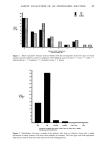
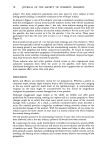
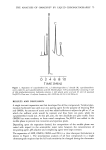
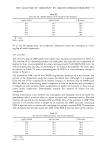
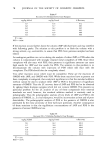
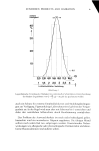
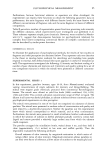
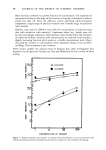
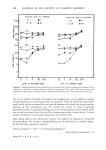
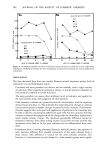
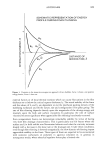
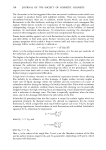
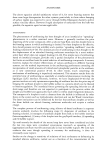
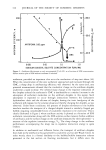
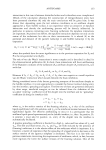
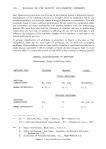
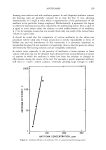
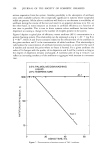
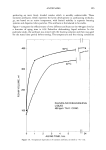
PSYCHOPHYSICAL MEASUREMENT 99 EXPERIMENTAL SERIES 2 In this experiment, panelists of similar age and background to those in Experimental Series 1 evaluated odor intensity, hedonics and quality by magnitude estimation (ratio scaling). The stimuli comprised two odorants, each presented at four concentration levels (20%, 5%, 1.25%, .3125% concentration in air). In addition, the odorants were paired so that each level of odorant A (Pulegone, a minty smell) was paired with every level of odorant B (Limonene, a lemon/lime or citrus smell). Altogether, this resulted in 24 stimuli. The stimuli in Experimental Series 2 were presented by means of a 24-channel, binary mixing olfactometer (7). The olfactometer passed a stream of deodorized, dry air over a sequence of four saturating tubes, which saturated the odor (approximately 95-98%), reduced saturation to 20% with odorless air, and then distributed the 20% saturated odorant at various flow rates to different channels. Three such streams were used: Stream A for odorant limonene (which was divided into 20 channels) Stream B for pulegone (also divided into 20 channels) and a stream of make-up, deodorized air. Every channel was presented at a final flow of 320 cc/min air, comprising X% of limonene, Y% of pulegone and (100-X-Y)% of odorless air. Figure 3 shows the dose-response function for odor intensity and for odor hedonics, for the pure, unmixed odorants. For hedonics, positive numbers reflect degrees of liking and negative numbers reflect degrees of disliking. Although negative numbers were permitted to show disliking (and 0 to show neutrality) the average liking ratings were all positive. Figure 4 shows the dose-response function for intensity and hedonics for the mixtures. Each odorant varies along a gradation of four levels (abscissa). The ordinate reflects the average magnitude estimates, and the parameter of each curve is the concentration of the second odorant added to the mixture. From Figure 3 it appears that unmixed odor intensity conforms to a power function. Furthermore, it is also apparent that over the 64/1 range of concentrations the exponent of the power function (or straight line in log-log coordinates) is less than 1.0, confirming the previous observation that odor intensity is a decelerating function of concentration. Finally, from the hedonic functions, it appears that these unmixed odorants increase in liking with concentration. The analysis of mixtures is slightly more difficult. These results in Figure 4 suggest that one odorant may suppress another. The exact degree of such suppression (or partial additivity, depending on one's point of view) has been modelled by vector addition of the form: Mixture Intensity 2 (AB) = A 2 + B 2 + 2AB cos 1) where A = Pulegone Sensory Intensity, B = Limonene Sensory Intensity. The foregoing 1 (8) states that the magnitude estimates of mixture intensity for two components (AB) can be predicted by squaring the magnitude estimate for one component (A2), adding it to the squared magnitude estimate of the second component (B2), and then adding their product--2AB cos (c•). Further, the values for c• should (a) be greater than 0 ø if partial additivity or partial suppression occurs (9) and (b) have empirically been found to range between 105 ø and 130 ø by several investigators (7, 8, 10).

100 JOURNAL OF THE SOCIETY OF COSMETIC CHEMISTS lOO :50 ø • 20 5O 20 • lO • 5 i RELAT'IVE LEVEL OF LIMONENE RELATIVE LEVEL OF PULEGONE [] i6 ß 6q [] 16 ß 64 1 i i i i ,- i i i i 0 1 4 16 64 0 1 4 16 64 LEVEL OF PULEGONE ADDED LEVEL OF LIMONENE ADDED Figure 4. Relation between the perceived odor intensity and odor hedonics (magnitude estimates) of one odorant, as a function of given additional four-fold increments of the other. The added odorant was presented in vapor phase to a vapor stream containing the reference odor. The coordinates are log-log. The vector model of intensity summation (and suppression) can be applied to ratings of odor intensity and odor liking (which are positive). Table IV shows the values for o• itself, which can be estimated for every pair of odorants since both the subjective odor intensity of the components and the mixture are known by direct magnitude estimation scaling. As a general finding, the vector model applies at intermediate levels but not at the extreme levels of one of the components where it breaks down. At these extreme levels there is noticeable suppression (o• exceeds 130ø). Odor liking shifts as the odorants are mixed. The addition of pulegone to limonene increases liking. The change in liking/disliking can be predicted, to a modest degree, by the following regression equation: Liking of mixture = 6.68 q- 0.11 (liking of pulegone) q- 0.64 (Liking of Limonene) (2) where R 2 = 0.52, R •- 0.72.
Purchased for the exclusive use of nofirst nolast (unknown)
From: SCC Media Library & Resource Center (library.scconline.org)