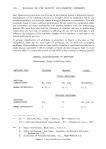
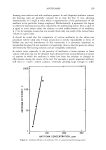
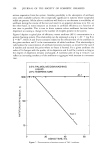
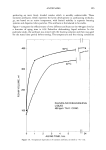
PSYCHOPHYSICAL MEASUREMENT 103 with concentration) in a dynamic airstream than in an evaluation of odorants which are dissolved in only liquid and smelled from an unstoppered bottle. Odor intensity in mid-ranges of odor intensity can be moderately well predicted by the vector model of additivity, but only if the ratings exhibit ratio-scale properties. That is, in order to use the vector model (or a similar quantitative model to predict mixture strength) the experimenter should have the individual evaluate odor intensity using magnitude estimation, which produces the appro- priate sensory ratio scale. A scale with fixed limits (1-5, 1-9) is not adequate for predictive purposes. The comparable analogy is a fixed thermometer scale, between 0 and 100. Few rules of thermodynamics can be reduced using such a scale. Rather, a scale with ratio properties, such as the absolute of Kelvin scale, must be used. Odor hedonics can be described by one of three patterns: (a) no change in hedonic pattern with shifts in odorant concentration (b) monotonic (continuous) decrease in liking, with increasing concentration and (c) slight increase in hedonic tone with concentration, followed by a decrease (rarest form). Odor hedonics (liking/disliking) cannot be easily modelled by a linear combina- tion of the hedonic values of the unmixed components evaluated themselves. The pattern which emerges is that there is only a modest correlation between the hedonic tones of components, and of mixtures, even when a linear, weighted, regression model is used for prediction purpose. A nonlinear model, developed on an ad hoc basis, provides a better fit. Whether this means that the linear model is incorrect but that another more complicated model is appropriate, or whether there is really no appropriate model which will serve as a general predictor, remains for future studies. It is difficult, if not impossible, to predict the sensory levels of qualities for an odor mixture, a priori, from knowledge of the intensity of the qualities of their components. This is, the specific modifications in sensory character of odorants in mixtures are difficult to predict, a priori, when the two odorants are combined in noninteracting, vapor phase mixtures. Despite these limitations, the prospects appear bright for a further understanding of odor perception by psychophysics. Furthermore, because psychophysics deals with quantitative relations between physical and psychological aspects of odorants (as well as among stimuli for other senses), psychophysics may be a timely tool for applications in the cosmetic industry. No doubt, as cosmetic chemists become increasingly familiar with methods of psychophysical scaling and with the body of psychophysical literature on taste, smell, color and texture perception, psychophysics should see increasing service and applications in product development, product evaluation and product optimization. REFERENCES (1) S.S. Stevens, On the brightness of lights and the loudness of sounds, Science, 118, 576 (1953). (2) S.S. Stevens, In Pursuit of the Psychophysical Law, Second Public Klopsteg Lecture, Northwestern University, Evanston, Ill., 1%2. (3) B. Berglund, U. Berglund, G. Ekman and T. Engen, Individual psychophysical functions for twenty-eight odorants, Perception & Psychophysics, 9, 379-384 (1971).

104 JOURNAL OF THE SOCIETY OF COSMETIC CHEMISTS (4) H. R. Moskowitz, Fragrance intensity measurement by magnitude estimation, Perfumer and Flavorist, 1, 18-25 (Oct./Nov. 1976). (5) H. R. Moskowitz, Sensory measurement: The rational experience--Its use, limitations and prospects, MBA Technical Quarterly, 14, 111-119 (1977). (6) W. S. Cain and H. R. Moskowitz, Psychophysical Scaling of Odor, in "Advances in Chemorecep- tion," J. Johnston, Jr., D. Mouton and A. Turk, Academic Press: New York, N.Y., 1974 Vol. III, pp 2-32. (7) H. R. Moskowitz, C. N. Dubose and Reuben, Flavor chemical mixtures - a psychophysical analysis, paper presented at the symposium, •Objective Measurement of Flavor Quality," R. Scanlan, Ed., American Chemical Society: California, 1977 pp 29-44. (8) B. Berglund, U. Berglund and T. Lindvail, On the principle of odor interaction, Acta Psychologica, 35, 255-268 (1973). (9) H. R. Moskowitz and C. Barbe, Profiling of odor components and their mixtures, Sencory Processes, 1, 212-226 (1977). (10) W. S. Cain, Odor intensity: Mixtures and masking, Chemical Senses and Flavor, 1,339-352 (1975).
Purchased for the exclusive use of nofirst nolast (unknown)
From: SCC Media Library & Resource Center (library.scconline.org)