ANTIFOAMS 107 force which results from the pressure drop across the curved interface of the bubbles. For lamellae separating bubbles of radius R, the pressure drop, Ap, is given by the LaPlace equation, Ap = 2'y/R, and this results in suction of the liquid into the Plateau borders of the foam. Thinning will continue until the bubbles rupture, or until an "equilibrium" film thickness is reached when the suction force is balanced by the film's "disjoining pressure" (2) which is made up of the residual forces in the film. We will now consider these in terms of energy, distance (thickness) profiles, writing them in summation as ETotal = Ev + Es + EE where E v is the contribution from van der Waals' interaction E s is the entropic or steric stabilization energy and E E is the electrical or coulombic interactional energy between the neighboring bubbles. While E v is generally attractive and promotes film thinning, E s and E E generally oppose and •eta•d el&ming. Actual estimatio,• of these energies can b•mad•inffre following way: Van der lVaals' Energy Ev is the van der Waals' energy of interaction between two foam bubbles which, in a conventional foam, are surrounded by a layer of adsorbed surfactant molecules. An estimate of this interaction energy can be made using Vold's (21) treatment, according to which Ev = --542 ((As •/2-- AM•/2)2Hs -3- AsHy d- 2Asl/•(AM 1/2-- As•/•)Hvs) In the above equation As and AM are the Hamaker constants of the foam stabilizing surfactant and the surrounding liquid medium, respectively. Hs, H? and Hvs are geometric functions, H(x,y), which are related to the distance of separation and the radius of the bubbles involved such that H(x,y) = y/(x•d-xyd-x) + y/(x2+xy+y+x) + 2In ((x•d-xyd-x)/x2-+-xyd-x-+-y) where x is the ratio of the minimum distance of separation between the bubbles and the diameter of the smaller bubble y is the ratio of bubble diameters, R1/R2, chosen for generality to be unequal so that y • 1, i.e., R 1 • R 2. Individual values of the H parameters are given by H s = H(A/2(R2 q- 15), (R, q- 15)/(R 2 -•- 15)) Hv = H((A d- 215)/2R2, R1/R2) nvs = H((A -f 15)/R2, (R• -f 15)/R2) where 15 and A are the thickness of the surfactant film adsorbed on the bubble surface and the thickness of the solution between the bubbles, respectively. From the above equations it is evident that the van der Waals' interactions will always be attractive as long as AM • As. However, under conditions where AM As, one can observe repulsive van der Waals' interactions. Thus the actual nature and magnitude of the van der Waals' interactions will be dependent not only on the 15 and A values, but also on the relative values of AM and A s.

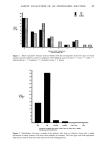
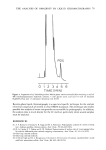
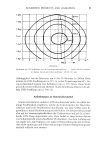
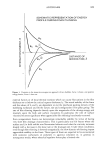
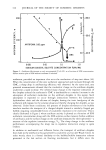
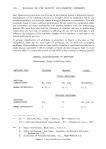
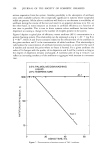
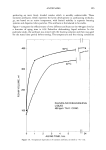
108 JOURNAL OF THE SOCIETY OF COSMETIC CHEMISTS Entropic Energy, E s Es is the energy contribution due to the steric interferences which bubbles experience as they approach one another. These contributions are not expected to be significant unless the film thins to a few nanometers thickness. This conclusion is particularly valid for surfactants in which the polar head groups are relatively small. For polymeric foam stabilizers and for nonionic surfactants, in which ethylene oxide or ethylene oxide/propylene oxide chains comprise the head group, the steric contribution is expected to be higher and to operate at longer distances. Electrical Energy, E• EE represents the energy contribution from coulombic forces. These interactions can be dominant in aqueous solutions of ionic surfactants. The electrical contribution for the case of spherical bubbles in aqueous solution at 25øC can be estimated using the equation of Hogg et al. (22,23). EE = 8.92 X 10 -•ø G •-2 [In (1 -3- exp (--KA)] where •' is the zeta potential of the bubble/solution interface, G is given by the formula, 1/G = 1/R• -3- l/R2, and K is the Debye-Huckel reciprocal length parame- ter in cm -• which is related to the total concentration, C, in mole/liter, of uni-univalent electrolyte in the solution by the expression, K = 0.328 X 10 -8 •/-•. The above equation applies for the condition of constant surface potential and nondeformability of the bubbles and assumes that the Gouy-Chapman model of the double layer interactions is applicable. The equation shows how the repulsive coulombic interaction increases as the bubbles come closer together and so opposes the film thinning. In summary, of the three energy factors involved, the coulombic and the steric energy factors will oppose thinning. The role of the van der Waals' term, Ev, is either to oppose or promote film thinning, depending upon the relative values of the Hamaker constants of the surfactant and the medium. The magnitude and the sign of all these energy factors are a direct function of film thickness, as is demonstrated in Figure 1, drawn on an arbitrary scale. Depending upon the relative values of each factor, two extreme possibilities can be foreseen. 1. The film thinning is favored energetically under all conditions, so that the film will finally rupture causing eventual foam collapse. 2. The film thins to a particular point beyond which further thinning requires crossing an activation energy barrier so that the film achieves a metastable equilibrium thickness. Further film thinning or film rupture requires an additional energy source which is capable of either altering the activation energy barrier or providing enough energy to overcome it. Corresponding to the above two conditions, two classes of foams are possible, viz., nonpersistent foams and persistent foams, respectively. In nonpersistent foams, film thinning is energetically always favored and the life span of the foam is primarily controlled by the rate of film thinning. On the other hand, in persistent foams, drainage and lamella thinning occur until an "equilibrium" film thickness, he, is reached. These foams are relatively stable and their breakdown is the result either of
Purchased for the exclusive use of nofirst nolast (unknown)
From: SCC Media Library & Resource Center (library.scconline.org)